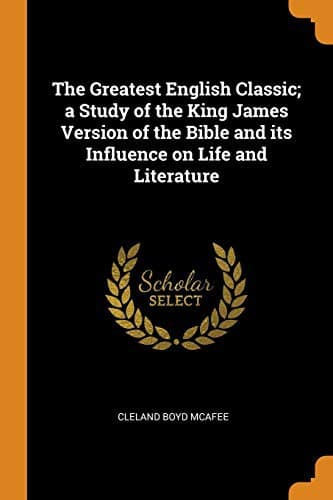
The Greatest English Classic: A Study of the King James Version of the Bible and Its Influence on Life and LiteratureMcAfee, Cleland Boyd
Religion
The Greatest English Classic: A Study of the King James Version of the Bible and Its Influence on Life and Literature
McAfee, Cleland Boyd
Bible -- History; Bible -- Influence; Bible and literature; Bible. English -- Versions -- Authorized
There is not need for extended word about the great Wesleyan movement in
the midst of this period, which has so profoundly affected both English
and American history. It has not worked out into such visible political
forms. But any movement that makes for larger spiritual life makes for the
strengthening of the entire life of the nation. The mere figures of the
early Wesleyan movement are almost appalling. Here was a man, John Wesley,
an Oxford scholar, who spent nearly fifty years traveling up and down and
back and forth through England on horseback, covering more than two
hundred and fifty thousand miles, preaching everywhere more than forty
thousand times, writing, translating, editing two hundred works. When
death ended his busy life there were in his newly formed brotherhood one
hundred and thirty-five thousand members, with five hundred and fifty
itinerants who were following his example with incessant preaching and
Bible exposition. It was the old Wiclif-Lollard movement over again. And
here was the other Wesley, Charles, teaching England to sing again,
teaching the old truths of the Bible in rhyme to many who could not read,
so that they became familiar, writing on horseback, in stage-coaches,
everywhere, writing with one passion, to help England back to the Bible
and its truth. Such activity could not leave the nation unmoved; all its
religious life felt it, and its political life from serf to king was
deeply affected by it. It is a common saying that the Wesleyan movement
saved English liberty from European entanglement. Yet the Wesleyan
movement issued from the Bible and led England back to the Bible.
But apart from these wide movements and the great souls who led them,
there is time for thought of one typical character on each side of the sea
who did not so much make a movement as he proved the point around which a
great fluid idea crystallized into strength. Across the sea the character
shall be that man whom Carlyle gave back to us out of obloquy and
misunderstanding, Oliver Cromwell. Choosing him, we pass other names which
crowd into memory, names of men who have served the need of England
well--Wilberforce, John Howard, Shaftesbury, Gladstone--who drew their
strength from this Book. Yet we choose Cromwell now for argument. On this
side it must be that best known, most beloved, most typical of all
Americans, Abraham Lincoln.
Public-domain text, read in full here on John Shaqi.
Reviews
Reviews
No reviews yet
Be the first to share your thoughts on this work.
Elsewhere in the archive
Join the Discussion
Join the discussion
Sign in to leave a comment or review.
Sign InorCreate an account