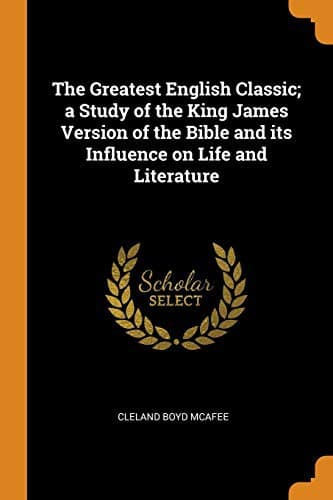
The Greatest English Classic: A Study of the King James Version of the Bible and Its Influence on Life and LiteratureMcAfee, Cleland Boyd
Religion
The Greatest English Classic: A Study of the King James Version of the Bible and Its Influence on Life and Literature
McAfee, Cleland Boyd
Bible -- History; Bible -- Influence; Bible and literature; Bible. English -- Versions -- Authorized
rattling down? Not Charles II.--you shall look in vain for him. Not George
Monk, who brought back the King--you shall not find him there. The one
statue which England has cared to plant beside its Parliament buildings is
that of Oliver Cromwell, its Lord Protector. There he stands, warning
kings in the interests of liberty. John Morley makes no ideal of him. He
thinks he rather closed the medieval period than opened the modern period;
but he will not have Cromwell compared to Frederick the Great, who spoke
with a sneer of mankind. Cromwell "belonged to the rarer and nobler type
of governing men, who see the golden side, who count faith, piety, hope
among the counsels of practical wisdom, and who for political power must
ever seek a moral base." That is a rare and noble type of men, whether
they govern or not. But no man of that type governs without red blood in
his veins; and the iron that made this man's blood run red came from the
English Bible.
It is a far cry from Oliver Cromwell to Abraham Lincoln--far in years, far
in deeds, far in methods, but not far in spirit. Great men are kindred,
generations over. We pass from the Old Testament into the New when we pass
from Cromwell to Lincoln; but we still feel the spirit of liberty. From
the days of the Puritans, the Quakers and the Dutch, history had been
preparing for this time. Benjamin Franklin had done his great work for
human liberty; he had summed up his hope for the nation in his memorable
address in 1787, when he stood eighty-one years old, before the convention
assembled to frame a constitution for the new government. He reminded them
that at the beginning of the contest with the British they had had daily
prayers in that room in Philadelphia for the Divine protection, and said:
"I have lived for a long time, and the longer I live the more convincing
proof I see of this truth, that God governs in the affairs of men. And if
a sparrow cannot fall to the ground without His notice, is it probable
that an empire can rise without His aid? We have been assured, Sir, in the
sacred writings, that 'Except the Lord build the house, they labor in vain
that build it.' I firmly believe this, and I also believe that without His
concurring aid we shall proceed in this political building no better than
the builders of Babel. I therefore beg leave to move that, henceforth,
prayers imploring the assistance of Heaven and its blessing on our
deliberation be held in this assembly every morning before we proceed to
business, and that one or more of the clergy of this city be requested to
officiate in that service."
Public-domain text, read in full here on John Shaqi.
Reviews
Reviews
No reviews yet
Be the first to share your thoughts on this work.
Elsewhere in the archive
Join the Discussion
Join the discussion
Sign in to leave a comment or review.
Sign InorCreate an account