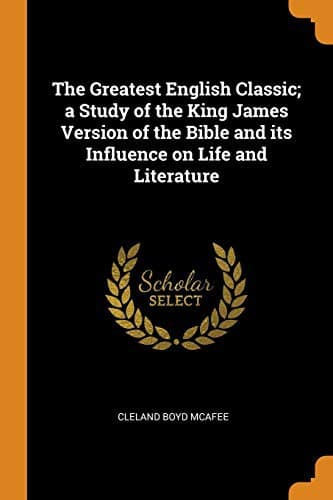
The Greatest English Classic: A Study of the King James Version of the Bible and Its Influence on Life and LiteratureMcAfee, Cleland Boyd
Religion
The Greatest English Classic: A Study of the King James Version of the Bible and Its Influence on Life and Literature
McAfee, Cleland Boyd
Bible -- History; Bible -- Influence; Bible and literature; Bible. English -- Versions -- Authorized
The line is unbroken. And it leads to this tall figure, crowned with a
noble head, his face the saddest in American history, who knew Gethsemane
in all its paths. The heart of the American people has always been touched
by his early years of abject poverty. But there were compensations. He had
few books, and they entered his blood and fiber. In his earliest formative
years there were six books which he read and re-read. Nicolay and Hay name
the Bible first in the list, with _Pilgrim's Progress_ as the fourth. Mr.
Morse calls it a small library, but nourishing, and says that Lincoln
absorbed into his own nature all the strong juice of the books.[46] How
much he drew from the pages of the Holy Book let any reader of his
speeches say. Quotation, reference, illustration crowd each other. The
phrases are familiar. The man is full of the Book. And what the man does
is part of the work of the Book.
One of his biographers says that there is nothing in the life or work of
Lincoln which cannot be explained without reference to any supernatural
influence or power. That depends on what is meant by supernatural. There
were no miracles, no astounding visions nor experiences. But there ran
into Lincoln's life from his young manhood onward this steady and strong
current of ideas and ideals from the Bible. In his second inaugural
address he worded the thought that was the deepest horror of the Civil
War--that on both sides of the strife men were reading the same Bible,
praying to the same God, and invoking His aid against each other! In that
very brief inaugural Mr. Lincoln quotes in full three Bible verses, and
makes reference to two others, and the whole address lasted barely four
minutes. There could be no mistaking the solemn importance of the fact to
which he referred in the inaugural, the presence on the other side of men
who held their Bibles high in regard. "Stonewall" Jackson was devout
beyond most men. The two books always at his hand were his Bible and the
_Manual of the Rules of War_. Robert E. Lee was a cultured, Christian
gentleman, as were many others with him, while throughout the South were
multitudes who loved and reverenced the Bible as fully as could any in the
North. As we look back over half a century, this comes out plainly: that
so far as the American civil war was a strife about union pure and simple,
having one nation or two here in our part of the continent, it was matter
of judgment, not of religion. There grew around that question certain
others of national honor and obligation, which were not so clear then as
now. But men on opposite sides of the question might read the same Bible
without finding authoritative word about it. In so far, however, as the
war had at its heart the matter of human slavery, it was possible for men
to differ only when one side read the letter of the Bible while the other
read its manifest spirit. Written in times when slavery was counted matter
of course, its letter dealt with slavery as a fact.
Public-domain text, read in full here on John Shaqi.
Reviews
Reviews
No reviews yet
Be the first to share your thoughts on this work.
Elsewhere in the archive
Join the Discussion
Join the discussion
Sign in to leave a comment or review.
Sign InorCreate an account