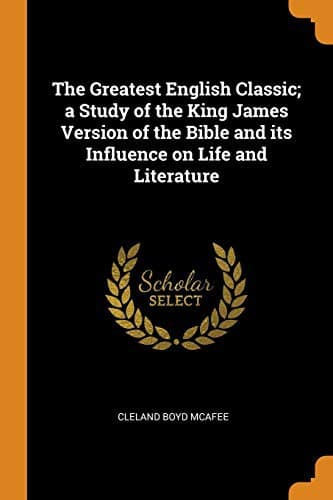
The Greatest English Classic: A Study of the King James Version of the Bible and Its Influence on Life and LiteratureMcAfee, Cleland Boyd
Religion
The Greatest English Classic: A Study of the King James Version of the Bible and Its Influence on Life and Literature
McAfee, Cleland Boyd
Bible -- History; Bible -- Influence; Bible and literature; Bible. English -- Versions -- Authorized
Under such guidance as this the people of England, Puritans and others,
relaxed the power of the Stuarts and became a democracy. For democracy is
not a form of government. It can exist under monarchy, provided the
monarchy is a convenience of the will of the people, as it is in England.
It can exist under institutions like our own, provided they also are held
as a convenience of the people. This was no rebellion against some form of
monarchy. It was simply a claim of every man to have his rights before
God. Under the Parliament of eighteen years duration, the Independents,
Presbyterians, and all other non-conforming bodies suffered as heavily as
under James and Charles, yet they did not flee the land. Their battle was
really won. They believed the time would come when they as part of "the
people" who now governed should assert themselves. If they were
persecuted, it was under a government where yet they might hope for their
rights. Fleeing from England in 1620 was heroism; fleeing in 1640 would
have been cowardly. It is impossible to calculate what was the revelation
to the readers of the English Bible of their rights.
Let Trevelyan tell the story: "While other literary movements, however
noble in quality, affect only a few, the study of the Bible was becoming
the national education. Recommended by the king, translated by the
Bishops, yet in chief request with the Puritans, without the rivalry of
books and newspapers, the Bible told to the unscholarly the story of
another age and race, not in bald generalization and doctrinal harangue,
but with such wealth of simple narrative and lyrical force that each man
recognized his own dim strivings after a new spirit, written clear in
words two thousand years old. A deep and splendid effect was wrought by
the monopoly of this Book as the sole reading of common households, in an
age when men's minds were instinct with natural poetry and open to receive
the light of imagination. A new religion arose, of which the mythus was
the Bible stories and the pervading spirit the direct relations of man
with God, exemplified in the human life. And, while imagination was
kindled, the intellect was freed by this private study of the Bible. For
its private study involved its private interpretation. Each reader, even
if a Churchman, became in some sort a church to himself. Hence the hundred
sects and thousand doctrines that astonished foreigners and opened
England's strange path to intellectual liberty. The Bible cultivated here,
more than in any other land, the growth of intellectual thought and
practice."[48]
Public-domain text, read in full here on John Shaqi.
Reviews
Reviews
No reviews yet
Be the first to share your thoughts on this work.
Elsewhere in the archive
Join the Discussion
Join the discussion
Sign in to leave a comment or review.
Sign InorCreate an account