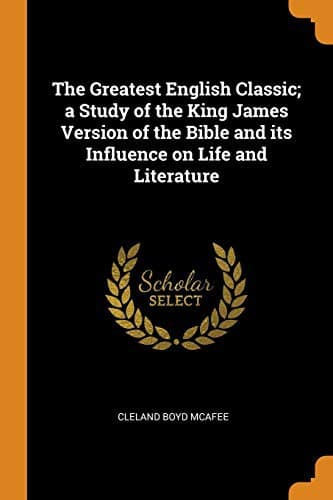
The Greatest English Classic: A Study of the King James Version of the Bible and Its Influence on Life and LiteratureMcAfee, Cleland Boyd
Religion
The Greatest English Classic: A Study of the King James Version of the Bible and Its Influence on Life and Literature
McAfee, Cleland Boyd
Bible -- History; Bible -- Influence; Bible and literature; Bible. English -- Versions -- Authorized
Several facts strengthen this persistent moral appeal. For one thing, the
Book is absolutely fair to humanity. It leaves out no line or wrinkle; but
it adds none. The men with whom it deals are typical men. The facts it
presents are typical facts. There are books which flatter men, make them
out all good, prattle on about the essential goodness of humanity, while
men who know themselves (and these are the only ones who do things) know
that the story is not true. On the other hand, there are books which are
depressing. Their pigments are all black. They move from the dignity of
Schopenhauer's pessimism to the bedlam of Nietzsche's contempt for life
and goodness. But here, also, the sane common sense of humanity comes to
the rescue. The picture is not true if it is all white or all black. The
Bible is absolutely fair to humanity. It moves within the circle of man's
experience; and, while it deals with men, it results in a treatment of
man.
That is how it comes about that the Bible inspires men, and puts them at
their best. No moral appeal can be successful if it fails to reach the
better part of a man, and lays hold on him there. Just what it did for the
English people. "No greater moral change ever passed over a nation than
passed over England during the years that parted the middle of the reign
of Elizabeth from the meeting of the Long Parliament. England became the
people of a Book, and that Book was the Bible."[50]
Add to that personal appeal and that absolute fairness to humanity the
constant challenge of the Bible to the nobler elements of humanity. It
never trifles. It is in deadly earnest. And it makes earnest men. Probably
we cannot illustrate that earnestness more clearly than by a study of one
element in Puritan history, which is confused in many minds. It is the
matter of the three great antagonisms of Puritanism in England and
America. They can never be understood by moral triflers. They may not be
approved by all the morally serious, but they will be understood by them.
What are those three marked antagonisms? The antagonism to the stage, to
popular frivolity, and to the pleasure of Sabbath.
Public-domain text, read in full here on John Shaqi.
Reviews
Reviews
No reviews yet
Be the first to share your thoughts on this work.
Elsewhere in the archive
Join the Discussion
Join the discussion
Sign in to leave a comment or review.
Sign InorCreate an account