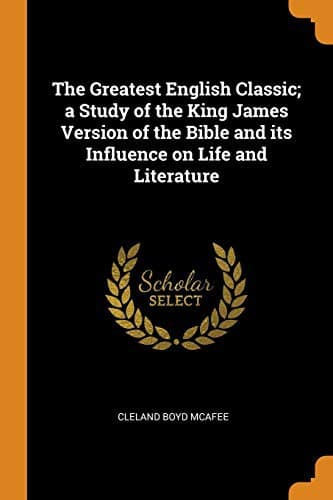
The Greatest English Classic: A Study of the King James Version of the Bible and Its Influence on Life and LiteratureMcAfee, Cleland Boyd
Religion
The Greatest English Classic: A Study of the King James Version of the Bible and Its Influence on Life and Literature
McAfee, Cleland Boyd
Bible -- History; Bible -- Influence; Bible and literature; Bible. English -- Versions -- Authorized
The need was keen enough.
About 1523 Tindale began to cast the Scriptures into the current English.
He set out to London fully expecting to find support and encouragement
there, but he found neither. He found, as he once said, that there was no
room in the palace of the Bishop of London to translate the New Testament;
indeed, that there was no place to do it in all England. A wealthy London
merchant subsidized him with the munificent gift of ten pounds, with which
he went across the Channel to Hamburg; and there and elsewhere on the
Continent, where he could be hid, he brought his translation to
completion. Printing facilities were greater on the Continent than in
England; but there was such opposition to his work that very few copies of
the several editions of which we know can still be found. Tindale was
compelled to flee at one time with a few printed sheets and complete his
work on another press. Several times copies of his books were solemnly
burned, and his own life was frequently in danger.
There is one amusing story which tells how money came to free Tindale from
heavy debt and prepare the way for more Bibles. The Bishop of London,
Tunstall, was set on destroying copies of the English New Testament. He
therefore made a bargain with a merchant of Antwerp, Packington, to
secure them for him. Packington was a friend of Tindale, and went to him
forthwith, saying: "William, I know thou art a poor man, and I have gotten
thee a merchant for thy books." "Who?" asked Tindale. "The Bishop of
London." "Ah, but he will burn them." "So he will, but you will have the
money." And it all came out as it was planned; the Bishop of London had
the books, Packington had the thanks, Tindale had the money, the debt was
paid, and the new edition was soon ready. The old document, from which I
am quoting, adds that the Bishop thought he had God by the toe when,
indeed, he found afterward that he had the devil by the fist.[7]
The final revision of the Tindale translations was published in 1534, and
that becomes the notable year of his life. In two years he was put to
death by strangling, and his body was burned. When we remember that this
was done with the joint power of Church and State, we realize some of the
odds against which he worked.
Public-domain text, read in full here on John Shaqi.
Reviews
Reviews
No reviews yet
Be the first to share your thoughts on this work.
Join the Discussion
Join the discussion
Sign in to leave a comment or review.
Sign InorCreate an account