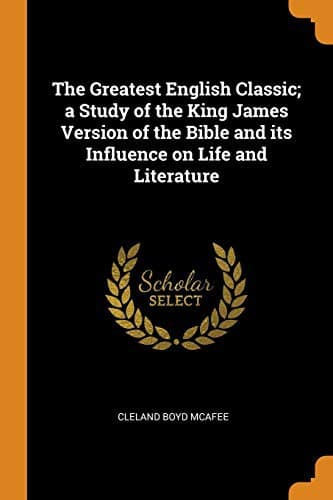
The Greatest English Classic: A Study of the King James Version of the Bible and Its Influence on Life and LiteratureMcAfee, Cleland Boyd
Religion
The Greatest English Classic: A Study of the King James Version of the Bible and Its Influence on Life and Literature
McAfee, Cleland Boyd
Bible -- History; Bible -- Influence; Bible and literature; Bible. English -- Versions -- Authorized
Yet that was not a mistaken move nearly forty years ago, when the revision
of the King James version was proposed and undertaken. Thirty years ago
(1881) it was completed in what we ordinarily call the Revised Version,
and ten years ago (1901) the American form of that Revised Version
appeared. Few things could more definitely prove the accepted place of the
King James version than the fact that we seem to hear less to-day of the
Revised Version than we used to hear, and that, while the American Revised
Version is incomparably the best in existence in its reproduction of the
original, even it makes way slowly. In less than forty years the King
James version crowded all its competitors off the field. The presence of
the Revised Version of 1881 has not appreciably affected the sales or the
demand for the King James version. In the minds of most people the English
and the American revisions stand as admirable commentaries on the King
James version. If one wishes to know wherein the King James version failed
of representing the original, he will learn it better from those versions
than from any number of commentaries; but the number of those to whom one
or other of the versions has supplanted the King James version is not so
large as might have been expected.
There were several reasons for a new English version of the Bible. It was,
of course, no indignity to the King James version. Those translators
frankly said that they had no hope to make a final version of the
Scriptures. It would be very strange if in three hundred years language
should not have grown by reason of the necessities of the race that used
it, so that at some points a book might be outgrown. In another lecture it
has been intimated that the English Bible, by reason of its constant use,
has tended to fix and confirm the English language. But no one book, nor
any set of books, could confine a living tongue. Some of the reasons for a
new version which give value to these two revisions may be mentioned.
1. Though the King James version was made just after the literary
renaissance, the classical learning of to-day is far in advance of that
day. The King James version is occasionally defective in its use of tenses
and verbs in the Greek and also in the Hebrew. We have Greek and Hebrew
scholars who are able more exactly to reproduce in English the meaning of
the original. It would be strange if that were not so.
Public-domain text, read in full here on John Shaqi.
Reviews
Reviews
No reviews yet
Be the first to share your thoughts on this work.
Elsewhere in the archive
Join the Discussion
Join the discussion
Sign in to leave a comment or review.
Sign InorCreate an account