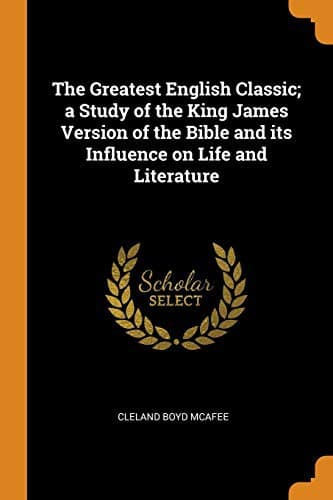
The Greatest English Classic: A Study of the King James Version of the Bible and Its Influence on Life and LiteratureMcAfee, Cleland Boyd
Religion
The Greatest English Classic: A Study of the King James Version of the Bible and Its Influence on Life and Literature
McAfee, Cleland Boyd
Bible -- History; Bible -- Influence; Bible and literature; Bible. English -- Versions -- Authorized
2. Then there have been new and important discoveries of Biblical
literature which date earlier in Christian history than any our fathers
knew three hundred years ago. In some instances those earlier discoveries
have shown that a phrase here or there has been wrongly introduced into
the text. There has been no marked instance where a phrase was added by
the revisers; that is, a phrase dropped out of the original and now
replaced. One illustration of the omission of a phrase will be enough. In
the fifth chapter of I John the seventh verse reads: "For there are three
that bear record in heaven, the Father, the Word, and the Holy Ghost, and
these three are one." In the revised versions it is omitted, because it
seems quite certain that it was not in the original writing. It does not
at all alter the meaning of Scripture. While it appears in most of the
best manuscripts which were available for the King James translators,
earlier manuscripts found since that time have shown that it was formerly
written at the side as a gloss, and was by some transcriber set over in
the text itself. The process of making the early manuscripts shows how
easily that could have occurred. Let us suppose that two or three
manuscripts were being made at once by different copyists. One was set to
read the original; as he read, the others wrote. It would be easy to
suppose that he might read this marginal reference as a suitable
commentary on the text, and that one or more of the writers could have
written it in the text. It could easily happen also that a copyist, even
seeing where it stood, might suppose it had been omitted by the earlier
copyist, and that he had completed his work by putting it on the margin.
So the next copyist would put it into his own text. Once in a manuscript,
it would readily become part of the accepted form. Discoveries that bring
that sort of thing to light are of value in giving us an accurate version
of the original Bible.
3. Then there are in our King James version a few archaic and obsolete
phrases. We have already spoken of them. Most of them have been avoided in
the revised versions. The neuter possessive pronoun, for example, has been
put in. Animal names have been clarified, obsolete expressions have been
replaced by more familiar ones, and so on.
Public-domain text, read in full here on John Shaqi.
Reviews
Reviews
No reviews yet
Be the first to share your thoughts on this work.
Elsewhere in the archive
Join the Discussion
Join the discussion
Sign in to leave a comment or review.
Sign InorCreate an account