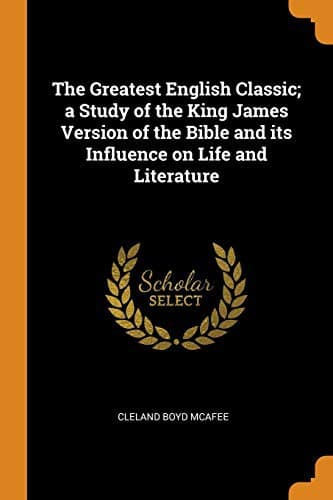
The Greatest English Classic: A Study of the King James Version of the Bible and Its Influence on Life and LiteratureMcAfee, Cleland Boyd
Religion
The Greatest English Classic: A Study of the King James Version of the Bible and Its Influence on Life and Literature
McAfee, Cleland Boyd
Bible -- History; Bible -- Influence; Bible and literature; Bible. English -- Versions -- Authorized
After that there was only a losing fight for the petitioners. They had
touched a sore spot in James's history. But it was when they touched that
sore spot again that they started the movement for a new version of the
Bible. It was on the second day of the conference, January 16th, that Dr.
Reynolds, president of Corpus Christi College, Oxford, who represented the
moderate Puritan position, and, like many moderate men, was rather
suspected by both extreme wings, instanced as one of the hardships of the
Puritans that they were compelled to use the prayer-book of the time, and
that it contained many mistranslations of Scripture, some of which he
quoted. Now, it so happens that the errors to which he referred occur in
the Bishops' and the Great Bible, which were the two authorized versions
of the time, but are all corrected in the Genevan version. We do not know
what point he was trying to make, whether he was urging that the Genevan
version should supplant these others, or whether he was calling for a new
translation. Indeed, we are not sure that he even mentioned the Genevan
version. But James spoke up to say that he had never yet seen a Bible well
translated into English; but the worst of all he thought the Genevan to
be. He spoke as though he had just had a copy given him by an English
lady, and had already noted what he called its errors. That was at the
very least a royal evasion, for if there was any Book he did know it was
the Genevan version. He had been fairly raised on it; he had lived in the
country where it was commonly used. It had been preached at him many and
many a time. Indeed, he had used it as the text for that paraphrase of the
Revelation of which we spoke a moment ago. And he knew its notes--well he
knew them--knew that they were from republican Geneva, and that kingly
pretensions had short shrift with them. James told the conference that
these notes were "very partial, untrue, seditious, savoring too much of
traitorous and dangerous conceits," supporting his opinion by two
instances which seemed disrespectful to royalty. One of these instances
was the note on Exodus i:17, where the Egyptian midwives are said to have
disobeyed the king in the matter of destroying the children. The note
says: "Their disobedience to the king was lawful, though their dissembling
was not." James quoted that, and said: "It is false; to disobey the king
is not lawful, and traitorous conceits should not go forth among the
people."
Some of the High Church party objected that there were translations enough
already; but it struck James's fancy to set them all aside by another
version, which he at once said he would order. It was to be made by the
most learned of both universities, then to be revised by the bishops and
other Church dignitaries, then presented to the Privy Council, and finally
to be passed upon by himself. There is the echo of some sharp Scotch
experiences in his declaration that there were to be no marginal notes in
that new version.
Public-domain text, read in full here on John Shaqi.
Reviews
Reviews
No reviews yet
Be the first to share your thoughts on this work.
Join the Discussion
Join the discussion
Sign in to leave a comment or review.
Sign InorCreate an account