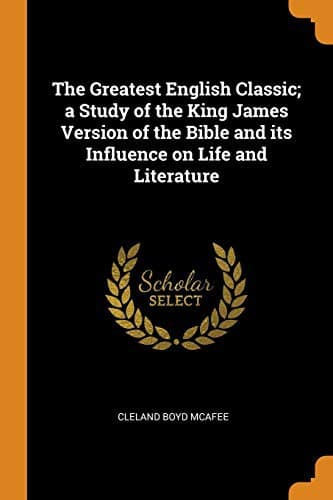
The Greatest English Classic: A Study of the King James Version of the Bible and Its Influence on Life and LiteratureMcAfee, Cleland Boyd
Religion
The Greatest English Classic: A Study of the King James Version of the Bible and Its Influence on Life and Literature
McAfee, Cleland Boyd
Bible -- History; Bible -- Influence; Bible and literature; Bible. English -- Versions -- Authorized
If we speak of the influence of the Bible on these men, it must be on
their literary work; and when we find it there, it becomes peculiar mark
of its power. They had little sense of it as moral law. Their consciences
approved it and condemned themselves, or else their delicate literary
taste sensed it as a book of power.
This is notably true of Shelley. When he was still a student in Oxford he
committed himself to the opinion of another writer, that "the mind cannot
believe in the existence of God." He tries to work that out fully in his
notes on "Queen Mab." When he was hardly yet of age he himself wrote that
"The genius of human happiness must tear every leaf from the accursed Book
of God, ere man can read the inscription on its heart." He once said that
his highest desire was that there should be a monument to himself
somewhere in the Alps which should be only a great stone with its face
smoothed and this short inscription cut in it, "Percy Bysshe Shelley,
Atheist."
It would seem that whatever Shelley drew of strength or inspiration from
the Bible would be by way of reaction; but it is not so. However he may
have hated the "accursed Book of God," his wife tells in her note on "The
Revolt of Islam" that Shelley "debated whether he should devote himself
to poetry or metaphysics," and, resolving on the former, he "educated
himself for it, engaging himself in the study of the poets of Greece,
England, and Italy. To these, may be added," she goes on, "a constant
perusal of portions of the Old Testament, the Book of Psalms, Job, Isaiah,
and others, the sublime poetry of which filled him with delight." Not only
did he catch the spirit of that poetry, but its phrases haunted his
memory. In his best prose work, which he called _A Defense of Poetry_,
there is an interesting revelation of the influence of his Bible reading
upon him. Toward the end of the essay these two sentences occur: "It is
inconsistent with this division of our subject to cite living poets, but
posterity has done ample justice to the great names now referred to. Their
errors have been weighed and found to have been dust in the balance; if
their sins are as scarlet, they are now white as snow; they have been
washed in the blood of the mediator and redeemer, Time." There is no more
eloquent passage in the essay than the one of which this is part, and yet
it is full of allusion to this Book from which all pages must be torn!
Even in "Queen Mab" he makes Ahasuerus, the wandering Jew, recount the
Bible story in such broad outlines as could be given only by a man who
was familiar with it. When Shelley was in Italy and the word came to him
of the massacre at Manchester, he wrote his "Masque of Anarchy." There are
few more melodious lines of his writing than those which occur in this
long poem in the section regarding freedom. Four of those lines are often
quoted. They are at the very heart of Shelley's best work. Addressing
freedom, he says:
Public-domain text, read in full here on John Shaqi.
Reviews
Reviews
No reviews yet
Be the first to share your thoughts on this work.
Elsewhere in the archive
Join the Discussion
Join the discussion
Sign in to leave a comment or review.
Sign InorCreate an account