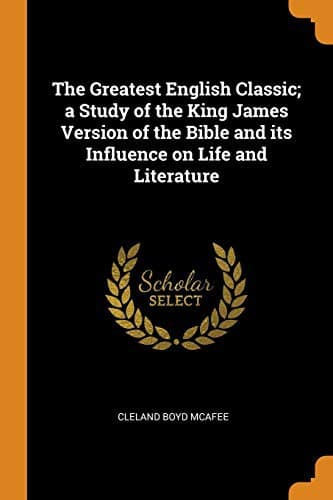
The Greatest English Classic: A Study of the King James Version of the Bible and Its Influence on Life and LiteratureMcAfee, Cleland Boyd
Religion
The Greatest English Classic: A Study of the King James Version of the Bible and Its Influence on Life and Literature
McAfee, Cleland Boyd
Bible -- History; Bible -- Influence; Bible and literature; Bible. English -- Versions -- Authorized
not only built directly out of Scriptural events, but imply a far wider
knowledge of Scripture than their mere titles suggest.
There are striking references in many other poems, even in his almost vile
poem, "Don Juan." The most notable instance is in the fifteenth canto,
where he is speaking of persecuted sages and these lines occur:
"Was it not so, great Locke? and greater Bacon?
Great Socrates? And Thou Diviner still,
Whose lot it is by men to be mistaken,
And Thy pure creed made sanction of all ill?
Redeeming worlds to be by bigots shaken,
How was Thy toil rewarded?"
In a note on this passage Byron says: "As it is necessary in these times
to avoid ambiguity, I say that I mean by 'Diviner still' _Christ_. If ever
God was man--or man God--He was both. I never arraigned His creed, but the
use or abuse of it. Mr. Canning one day quoted Christianity to sanction
slavery, and Mr. Wilberforce had little to say in reply. And was Christ
crucified that black men might be scourged? If so, He had better been born
a mulatto, to give both colors an equal chance of freedom, or at least
salvation." Byron could live far from the influence of the Bible in his
personal life; but he never escaped its influence in his literary work.
Of Coleridge less needs to be said, because we think of him so much in
terms of his more meditative musings, which are often religious. He
himself tells of long and careful rereadings of the English Bible until he
could say: In the Bible "there is more that finds me than I have
experienced in all other books together; the words of the Bible find me at
greater depths of my being." Of course, that would influence his writing,
and it did. Even in the "Rime of the Ancient Mariner" much of the
phraseology is Scriptural. When the albatross drew near,
"As if it had been a Christian soul,
We hailed it in God's name."
When the mariner slept he gave praise to Mary, Queen of Heaven. He sought
the shriving of the hermit-priest. He ends the story because he hears "the
little vesper bell" which bids him to prayer. When you read his "Hymn
Before Sunrise in the Vale of Chamounix" you find yourself reading the
Nineteenth Psalm. He calls on the motionless torrents and the silent
cataracts and the great Mont Blanc itself to praise God. Coleridge never
had seen Chamounix, nor Mont Blanc, nor a glacier, but he knew his Bible.
So he has his Christmas Carol along with all the rest. His poem of the
Moors after the Civil War under Philip II. is Scriptural in its
phraseology, and so is much else that he wrote. Frankly and willingly he
yielded to its influence. In his "Table Talk" he often refers to the value
of the Bible in the forming of literary style. Once he said: "Intense
study of the Bible will keep any writer from being vulgar in point of
style."[35]
Public-domain text, read in full here on John Shaqi.
Reviews
Reviews
No reviews yet
Be the first to share your thoughts on this work.
Elsewhere in the archive
Join the Discussion
Join the discussion
Sign in to leave a comment or review.
Sign InorCreate an account