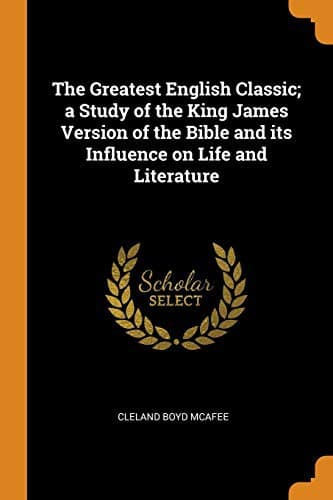
The Greatest English Classic: A Study of the King James Version of the Bible and Its Influence on Life and LiteratureMcAfee, Cleland Boyd
Religion
The Greatest English Classic: A Study of the King James Version of the Bible and Its Influence on Life and Literature
McAfee, Cleland Boyd
Bible -- History; Bible -- Influence; Bible and literature; Bible. English -- Versions -- Authorized
Not so much can be said of Swinburne. There was a strong infusion of acid
in his nature, which no influence entirely destroyed. He is apt to live as
a literary critic and essayist, though he supposed himself chiefly a poet.
His own thought of poetry can be seen in his protest in behalf of
Meredith. When he had been accused of writing on a subject on which he had
no conviction to express ("Modern Love"), Swinburne denied that poets
ought to preach anyway. "There are pulpits enough for all preachers of
prose, and the business of verse writing is hardly to express
convictions." Yet it is impossible to forget Milton and his purpose to
"assert Eternal Providence, and justify the ways of God to men."
Naturally, most poets do preach and preach well. Wordsworth declared he
wanted to be considered a teacher or nothing. Mrs. Browning thought that
poets were the only truth-tellers left to God. But Swinburne could not
help a little preaching at any rate. His "Masque on Queen Bersaba" is an
old miracle play of David and Nathan. His "Christmas Antiphones" are
hardly Christian, though they are abundant in their allusions to
Scripture. The first is a prayer for peace and rest in the coming of the
new day of the birth of Christ. The second is a protest that neither God
nor man has befriended man as he should, and the third is an assurance
that men will do for man even if God will not. Now, that is not Christian,
but the Bible phrases are all through it. So when he writes his poem
bemoaning Poland, he needs must head it "Rizpah." At the same time it must
be said that Swinburne shows less of the influence of the Bible in his
style and in his spirit than any other of our great English writers.
Public-domain text, read in full here on John Shaqi.
Reviews
Reviews
No reviews yet
Be the first to share your thoughts on this work.
Elsewhere in the archive
Join the Discussion
Join the discussion
Sign in to leave a comment or review.
Sign InorCreate an account