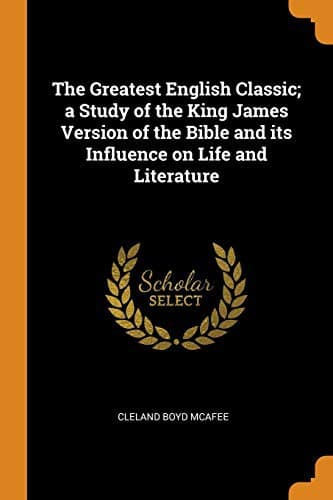
The Greatest English Classic: A Study of the King James Version of the Bible and Its Influence on Life and LiteratureMcAfee, Cleland Boyd
Religion
The Greatest English Classic: A Study of the King James Version of the Bible and Its Influence on Life and Literature
McAfee, Cleland Boyd
Bible -- History; Bible -- Influence; Bible and literature; Bible. English -- Versions -- Authorized
We come back again into the atmosphere of strong Bible influence when we
name Alfred Tennyson. When Byron died, and the word came to his father's
rectory at Somersby, young Alfred Tennyson felt that the sun had fallen
from the heavens. He went out alone in the fields and carved in the
sandstone, as though it were a monument: "Byron is dead." That was in the
early stage of his poetical life. At first Carlyle could not abide
Tennyson. He counted him only an echo of the past, with no sense for the
future; but when he read Tennyson's "The Revenge," he exclaimed, "Eh, he's
got the grip o' it"; and when Richard Monckton Milnes excused himself for
not getting Tennyson a pension by saying his constituents had no use for
poetry anyway, Carlyle said, "Richard Milnes, in the day of judgment when
you are asked why you did not get that pension, you may lay the blame on
your constituents, but it will be you who will be damned!" Dr. Henry van
Dyke studied Tennyson to best effect at just this point. In his chapter on
"The Bible in Tennyson" are many such sayings as these: "It is safe to say
that there is no other book which has had so great an influence upon the
literature of the world as the Bible. We hear the echoes of its speech
everywhere, and the music of its familiar phrases haunts all the field and
grove of our fine literature. At least one cause of his popularity is that
there is so much Bible in Tennyson. We cannot help seeing that the poet
owes a large debt to the Christian Scriptures, not only for their
formative influence on his mind and for the purely literary material in
the way of illustrations and allusions which they have given him, but also
for the creation of a moral atmosphere, a medium of thought and feeling in
which he can speak freely and with an assurance of sympathy to a very wide
circle of readers."
I need not stop to indicate the great poems in which Tennyson has so often
used Scripture. The mind runs quickly to the little maid in "Guinevere,"
whose song, "Late, Late, so Late," is only a paraphrase of the parable of
the foolish virgins. "In Memoriam" came into the skeptical era of
England, with its new challenge to faith, and stopped the drift of young
men toward materialism. Recall the fine use he makes, in the heart of it,
of the resurrection of Lazarus, and other Biblical scenes. Dr. van Dyke's
"four hundred direct references to the Bible" do not exhaust the poems. No
one can get Tennyson's style without the English Bible, and no one can
read Tennyson intelligently without a fairly accurate knowledge of the
Bible.
Public-domain text, read in full here on John Shaqi.
Reviews
Reviews
No reviews yet
Be the first to share your thoughts on this work.
Elsewhere in the archive
Join the Discussion
Join the discussion
Sign in to leave a comment or review.
Sign InorCreate an account