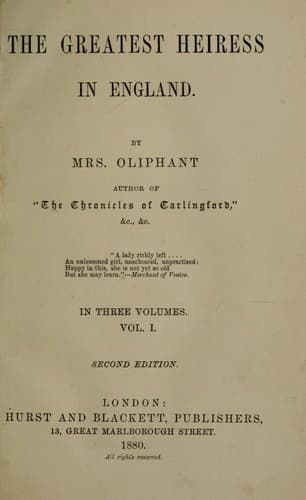
The Greatest Heiress in EnglandOliphant, Mrs. (Margaret)
General
The Greatest Heiress in England
Oliphant, Mrs. (Margaret)
England -- Fiction; Inheritance and succession -- Fiction
“You ought to lay by half of it,” old Lady Betsinda Molyneux was saying
at the very moment when Lucy, with tranquil pleasure, aided by Jock, in
a state of half-resentful, half-happy excitement, was putting a set of
pretty books into the low book-shelves that lined her little
sitting-room; “you ought to lay by one half of it. Good life! a girl
like that to get the advantage of being in your house at all! Instead of
petting her, and getting her everything that you can think of, she ought
to be too thankful if you put her in the housemaid’s closet. If you
don’t show a little wisdom now I will despair of you, my dear,” the old
lady said. She was an old lady of the first fashion; but she was, all
the same, a very grimy old lady with a mustache, and a complexion which
suggested coal dust rather than _poudre de riz_. Her clothes would have
been worth a great deal to an antiquary, notwithstanding that they were
all shaped, more or less, in accordance with the fashion; but they gave
Lady Betsinda the air of an animated rag-bag; and she wore a profusion
of lace, clouds of black upon her mantle, and ruffles of white about her
thin and dingy neck; but it would have been a misnomer, and also an
insult, to call that lace white. It was frankly dirty, and toned to an
indescribable color by years and wear. She was worth a small fortune
where she stood with all her old trumpery upon her; and yet a clean old
woman in a white cap and apron would have been a much fairer spectacle.
Her rings flashed as she moved her quick bony wrinkled hands, which were
of a color as indescribable as her lace. It would have been hard to have
seen any signs of noble race in Lady Betsinda’s hands; and yet the queer
old figure hung round with festoons of lace, and clothed in old black
satin as thick as a modern party-wall, could not have been anything but
that of a woman of rank. Her garments smelled not of myrrh and
frankincense, but of camphor, in which they were always put away to
preserve them; and the number of times these garments had been through
the hands of Lady Betsinda’s patient maid, and the number of stitches
that were required to keep them always in order, was more than anybody,
except the hard-worked official who had charge of the old lady’s
wardrobe, could say.
Public-domain text, read in full here on John Shaqi.
Reviews
Reviews
No reviews yet
Be the first to share your thoughts on this work.
Elsewhere in the archive
Join the Discussion
Join the discussion
Sign in to leave a comment or review.
Sign InorCreate an account