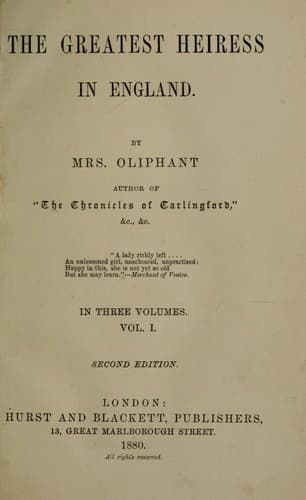
The Greatest Heiress in EnglandOliphant, Mrs. (Margaret)
General
The Greatest Heiress in England
Oliphant, Mrs. (Margaret)
England -- Fiction; Inheritance and succession -- Fiction
“I think so, too,” said a small and delicate person who was seated in a
deep low chair upon the other side of the fire. She was not old like
Lady Betsinda. She was a fragile little pale woman approaching fifty,
the wife of an eminent lawyer, and a little leader of society in her
way. She wrote a little, and drew a little, and sung a little, and was a
great patroness of artists, to whom, it need not be said, Mrs.
Berry-Montagu was very superior, gracious to them as a queen to her
courtiers; while young painters, and young writers, and young actors
were very obsequious to her, as to a woman who could, their elders told
them, “make their fortunes.” And there was more truth than usual in
this, for though Mrs. Berry-Montagu could not make anybody’s fortune she
could do something to mar it, and very frequently exercised that less
amiable power, writing pretty little _critiques_ which made the young
people wince, and damning their best efforts with elegant depreciation.
These were two of the friends who took Lady Randolph’s moral character
and social actions under their control. Most women, especially those who
are widows, have a superintending tribunal of this description, before
which all their actions are judged; and nowhere does the true dignity of
the woman who is married come out with more imposing force than in such
circumstances. Lady Betsinda was vehement; she was old and the daughter
of a duke, and had a very good right to say what she pleased, and keep
the rest of the world in order. But Mrs. Berry-Montagu was, so to speak,
two people. Her views were enlarged, as everybody acknowledged tacitly
by her possession of that larger shadow of a husband behind her, and she
had a great, unexpressed contempt for all women who were without that
dual dignity. A smile of the softest disdain--nay, the word is too
strong, and so is derision also much too potent for the delicate subdued
amusement with which she contemplated the doings of the _femme sole_ of
all classes--hovered about her lips. This did not spring from any
special devotion on her part to her husband, or faith in him, but only
from her consciousness of her own good fortune and dignity, and the high
position she occupied in consequence of his existence. We have given too
much space to the description of Lady Randolph’s privy council. Has not
every solitary woman in society a governing body which is much, the
same?
“I think so, too,” Mrs. Berry-Montagu said; “you ought really to think
of yourself a little; self-renunciation is a beautiful virtue; but then
we are not called upon to exercise it for everybody, and a girl of this
description is fair game.”
“If I were a hunter,” said Lady Randolph.
Public-domain text, read in full here on John Shaqi.
Reviews
Reviews
No reviews yet
Be the first to share your thoughts on this work.
Elsewhere in the archive
Join the Discussion
Join the discussion
Sign in to leave a comment or review.
Sign InorCreate an account