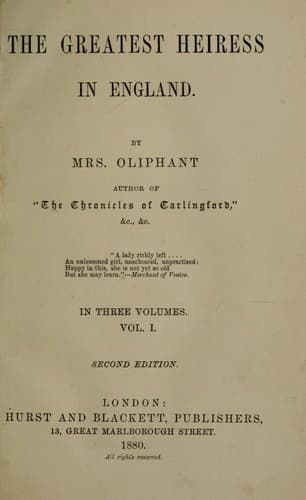
The Greatest Heiress in EnglandOliphant, Mrs. (Margaret)
General
The Greatest Heiress in England
Oliphant, Mrs. (Margaret)
England -- Fiction; Inheritance and succession -- Fiction
“But I don’t think I should like it at all.”
“There!” he cried, “that is always how it is; you and me never like the
same things. I suppose it is because you are a girl.” This Jock said
more regretfully than contemptuously, for he was very fond of his
sister, and then he added, with a little sigh, not of sorrow, but of
resigned acceptance of a commonplace sort of expedient, not absolutely
good, but the best in the circumstances, “I suppose you had better send
me to school.”
CHAPTER XX.
THE RUSSELLS.
“That is just what I was thinking,” Lady Randolph said, “we can do two
things, Lucy, two benefits at once. I know just the place for little
Jock! since he wants to go to school--with a poor lady whom you will
like to help--and,” she added, with a little softening of compassion,
“where you could go to see him often; and he could come--” this addition
was less cordial. Lady Randolph was a woman too easily led away by her
feelings. She thought of her committee, and restrained herself. “Katie
Russell must have told you about her mother. She has taken a house at
Hampstead, or one of those places, and is trying to set up a little
school. We are all on the outlook for Indian children, or, indeed,
pupils of any kind. Jock will be quite happy there. She will take an
interest in him as your brother, I have got her address somewhere. Shall
we go and look her up to-day?”
Lucy’s eyes, before she replied, traveled anxiously to Jock’s face to
read that little chart of varying sentiment, and take her guidance from
it. But Jock’s face said nothing. He could not any longer lie on the
hearth-rug, but he was doubled up in a corner by the fire, reading, as
usual, one of the books with which Lady Randolph had thought it proper
to supply him--a proper little story about little boys, supposed to be
adapted to the caliber of eight years old. Perhaps it was more fit for
him than the “History of the Plague,” but he did not like it so well.
“I think that would be very nice, Lady Randolph,” said Lucy, doubtfully.
“Well, my dear, we can but go and see. Jock is too young to judge for
himself; but he can come, too, and tell you how he likes it. Mrs.
Russell is very kind, I believe. She is, also, rather feeble, and does
not know quite so well what she would be at as one could wish. She is
always changing her plans. It may help to fix her if we take her a
pupil. It is a great blessing,” Lady Randolph said, with a sigh, “when
people know their own mind--especially poor people who have to be helped
by their friends.”
“I wonder,” said Lucy, “if it is more difficult to be poor than to be
rich.”
“Oh, there can be little doubt about that--for women, at least. I am not
in the least sorry for the butchers and bakers--they have their
trade--or for our house-maids, which is the same thing; but you and I,
Lucy. If anything were to happen, if we were to lose all our money, what
should we do?”
Public-domain text, read in full here on John Shaqi.
Reviews
Reviews
No reviews yet
Be the first to share your thoughts on this work.
Elsewhere in the archive
Join the Discussion
Join the discussion
Sign in to leave a comment or review.
Sign InorCreate an account