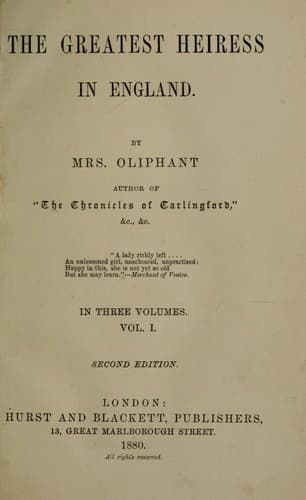
The Greatest Heiress in EnglandOliphant, Mrs. (Margaret)
General
The Greatest Heiress in England
Oliphant, Mrs. (Margaret)
England -- Fiction; Inheritance and succession -- Fiction
“I should not be afraid,” said Lucy, quietly, “for you know I was born
poor, but to have a great deal of money, and not know how to employ
it--that was always what papa said. He gave me a great many directions;
but I don’t know if I understood them, and sometimes I do not feel sure
whether he understood. Life is different here and at the Terrace, Lady
Randolph.”
“Very different, my dear; but you need not bewilder your poor little
head just yet. You will be older, you will have more experience before
you have any occasion to trouble yourself about the employment of your
money. I have no doubt all the investments are excellent--your father
had a good business head.”
“It was not about investments I was thinking,” Lucy said. “I have no
power over them.”
“Nor over anything else, fortunately, at your present age,” Lady
Randolph said, with a smile. “We may all be very thankful for that; for
I fear, unless you are very unlike other girls, that you would throw a
good deal of it away.” Lucy did not smile, or take any notice of this
pleasantry. Her next remark was very serious. “Don’t you think,” she
said, “that it is very wrong for me to be so rich, when others are so
poor?”
“A little Radical,” cried Lady Randolph, with a laugh. “Why, Lucy, I
never thought a proper little woman like you would entertain such
revolutionary sentiments.”
“You see,” said Lucy, very gravely, “it is upon me the burden falls;
every one feels most what is most hard upon themselves.”
Lady Randolph laughed again, but this time with a puzzled air.
“Hard upon you!” she said. “My dear, half the girls in England--and the
men, too--would give their heads to have half so much reason to
complain.”
“Men, perhaps, might understand better, Lady Randolph; but it is
altogether very strange. Papa must have known a great deal better; but
he did nothing himself. All that he wanted, so far as I can make out,
was to make more and more money; and then left the use of it--the
spending of it--to a girl that knows nothing. I never took much thought
of this while he was living, but I feel very bewildered now.”
“Wait a little,” Lady Randolph said, “you will find it very easy after
awhile; and, when you marry, your husband will give you a great deal of
assistance. In England you can never be at a loss in spending the
largest income; and the more you have, the more satisfactorily you can
spend it, the better return you have for your money. It is among us poor
people that money is most unsatisfactory. It never brings so much as it
ought,” she said, with that air of playfulness which, on such subjects,
is the usual disguise for the most serious feeling. Lucy looked up at
her with a gravity that disdained all disguise.
“But you do not mean to say, Lady Randolph, that _you_ are poor?”
Public-domain text, read in full here on John Shaqi.
Reviews
Reviews
No reviews yet
Be the first to share your thoughts on this work.
Elsewhere in the archive
Join the Discussion
Join the discussion
Sign in to leave a comment or review.
Sign InorCreate an account