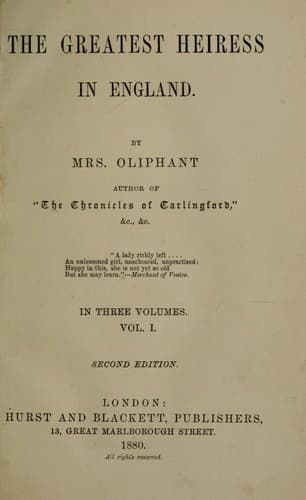
The Greatest Heiress in EnglandOliphant, Mrs. (Margaret)
General
The Greatest Heiress in England
Oliphant, Mrs. (Margaret)
England -- Fiction; Inheritance and succession -- Fiction
“What does the little witch mean?” he asked himself, with consternation
and bewilderment but what could be done? He went out straightway, and
after awhile he managed to get her the hundred pounds. A baronet with a
good estate and some reputation, even though he may have no money to
speak of, can always manage that. And Lucy accepted it from him quite
serenely, as if it had been a shade of Berlin wool, showing on her side
no embarrassment, nor any sense that it was inappropriate that he should
be her creditor. She gave him only a smile and a thank you, and
apparently thought nothing more of it. Sir Thomas was fairly struck dumb
with the adventure: but to Lucy, so far as he could make out, it was the
most every-day occurrence. She sent her maid to Hampstead that
evening--dressing for dinner by herself, a thing which Lucy, not trained
to attendance, was always secretly relieved to do--with a basket of
strawberries for Jock, and a letter for Mrs. Russell, and the girl’s
face beamed when she came down-stairs. They took her to the opera that
evening, where Lucy sat very tranquilly, veiled by the curtains of the
box, and listened conscientiously, though she showed no signs of
enthusiasm. She had a private little song of her own going on all the
while in her heart.
CHAPTER XXVII.
LUCY’S FIRST VENTURE.
While Lucy’s mind was thus soothed and comforted by the consciousness of
doing her duty, a very different effect was produced upon her father’s
executors, who, it is scarcely necessary to say, regarded her attempt to
fulfill the commands of the secret codicil with mingled consternation
and fury. Mr. Chervil, who, being at hand, was the first representative
of these legal authorities to be appealed to on the matter, had obeyed
her first call with some surprise, and had been, as was not unnatural,
driven nearly frantic by the quiet intimation given him by the little
girl, whom he looked upon as a child, that she intended to use the power
intrusted to her.
“What do you know about Codicil F?” he said. “I don’t know that there is
any Codicil F. I don’t believe in it. You are under a mistake, Miss
Lucy;” but when she made it apparent to him that her means of knowing
were unquestionable, and her determination absolute, Mr. Chervil went a
step further--he blasphemed. “It is against every law,” he said. “I
don’t believe it would stand in any court. I don’t feel that I should be
justified in paying any attention to it. I am sure Rushton would be of
my opinion. It was a mere piece of folly, downright madness, delusion-- I
don’t know what to call it.”
“But whatever it is,” said Lucy, with great prudence, putting forth no
theory of her own, “what papa said is law to me.” And though his
resistance was desperate she held her own with a gentle pertinacity.
Public-domain text, read in full here on John Shaqi.
Reviews
Reviews
No reviews yet
Be the first to share your thoughts on this work.
Elsewhere in the archive
Join the Discussion
Join the discussion
Sign in to leave a comment or review.
Sign InorCreate an account