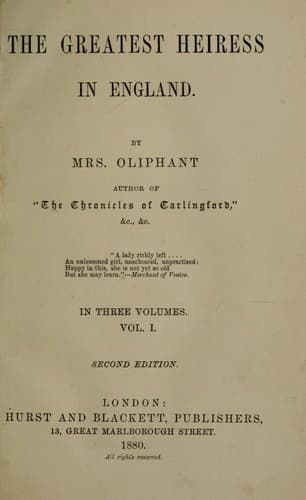
The Greatest Heiress in EnglandOliphant, Mrs. (Margaret)
General
The Greatest Heiress in England
Oliphant, Mrs. (Margaret)
England -- Fiction; Inheritance and succession -- Fiction
Lucy’s aspect was so entirely that of a submissive and dutiful girl; she
was so modestly commonplace, so unlike a heroine, that it was a long
time before he could believe that this little creature really meant to
make a stand upon her rights. He could scarcely believe, even, that she
understood what those rights were, or could stand for a moment against
his denial of them. When he was driven to remonstrance, a chill of
discouragement succeeded the first fury of his refusal. He tried every
oratorical art by sheer stress of nature, denouncing, entreating,
imploring all in a breath.
“It is like something out of the Dark Ages,” he cried. “It is mere
demoralization. You will make a race of paupers, you will ruin the
character of every person who comes near you. For God’s sake! Miss Lucy,
think what you want to do. It is not to give away money, it is to spread
ruin far and wide--ruin of all the moral sentiments; you will make
people dishonest, you will take away their independence, you will be
worse than a civil war! And look here,” cried the executor, desperate,
“perhaps you think you will get gratitude for it, that people will think
you a great benefactor? Not a bit of them! You will sow the wind and
reap the whirlwind,” he cried, wrath and despair driving him to that
great storehouse of poetry with which early training still supplies the
most commonplace of Englishmen.
Lucy listened with great attention, and it was an effort for her to
restrain her own awe and respect for “a gentleman,” and the almost
terror with which his excitement, as he paced about her little dainty
room, shaking the whole house with his hasty steps, filled her. To see
her mild countenance, her slight little form, under the hail-storm of
his passion, was half pathetic and half ludicrous. Sometimes she cried,
sometimes trembled, but never gave in. Other stormy interviews followed,
and letters from Mr. Rushton, in which every argument was addressed both
to her “good sense” and “good feeling;” but Lucy had neither the good
sense to appreciate their conscientious care of her money nor the good
feeling to allow that her father had in this particular acted like a
fool or a madman. She was wise enough to attempt no argument, but she
never gave in; there were moments, indeed, when the two men were in
hopes that they had triumphed; but these were only when Lucy herself was
wavering and discouraged in regard to the Russells, and unable to decide
what to do. The evening after her final interview with Mrs. Russell she
sent for Mr. Chervil again; and it was not without a little panic and
beating of her heart that Lucy looked forward to this conclusive
meeting. She had to prop herself up by all kind of supports, recalling
to herself the misery she had seen, and the efforts to conceal that
misery, which were almost more painful still to behold, and, on the
other hand, the precision of her father’s orders, which entirely suited
Public-domain text, read in full here on John Shaqi.
Reviews
Reviews
No reviews yet
Be the first to share your thoughts on this work.
Elsewhere in the archive
Join the Discussion
Join the discussion
Sign in to leave a comment or review.
Sign InorCreate an account