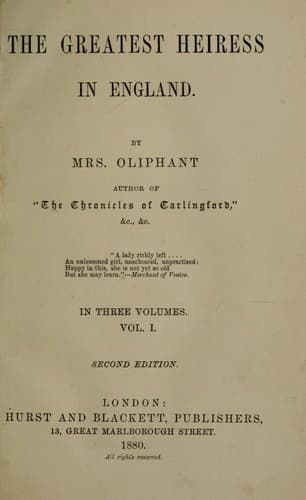
The Greatest Heiress in EnglandOliphant, Mrs. (Margaret)
General
The Greatest Heiress in England
Oliphant, Mrs. (Margaret)
England -- Fiction; Inheritance and succession -- Fiction
This was the matter, however: that one of the newspapers of which
society is so fond had taken up the romantic dedication of “Imogen,”
and with an industry that might have been praiseworthy (as the police
reports say) if employed in a better cause, had ferreted out a still
more romantic edition of the story. It was not true, but what had that
mattered? It gave a fancy sketch of Lucy, and her heiress-ship, and her
rusticity, and described how the young novelist was to be rewarded with
the hand of the wealthy object of his devotion, a devotion which had
begun while she was still poor. Lucy had not learned to care for
newspapers, and it was not at all difficult to keep it from her. But Sir
Thomas gave all belonging to him a great deal of trouble to soothe him
down, and persuade him that nobody cared for such assaults.
“It is quite good-natured; there is no harm intended,” Lady Randolph
said; “we all get a touch now and then.”
“If that is no harm a punch on the head is still more innocent,” said
Sir Thomas, savagely, and it was almost by force, and solely because of
the fact that this would be still worse for Lucy, that he was
restrained. But Lucy never heard of it, and the article sold off at
once, before a month was out, the whole edition of “Imogen.”
CHAPTER XXVIII.
GOING HOME.
And now the period of Lucy’s first experiment in life was over. From all
the delicacies with which Lady Randolph’s care had surrounded her, and
from the atmosphere of refinement to which she had grown accustomed, it
was now the moment to descend and go back to the homely house which Jock
and she instinctively still called “home.” He had come in from Hampstead
a day or two before, and lived with Lucy in her little sitting-room,
while all the packing went on. The limit of the six months had been
relaxed a little, to suit Lady Randolph’s convenience, who considered
(as did her doctor) that after the fatigues of the season Homburg was a
necessity for her. On ordinary occasions Lady Randolph spent a month at
the Hall before she went to Homburg: but she had not thought it prudent
this year to take Lucy there, so they had stayed in town till the parks
were like brown paper, and the shutters were up in all the houses. This
was a thing that had not happened to Lady Randolph for a long time, and
she felt that she was something of a martyr, and that it was for Lucy’s
sake. However, at last the long days came to an end. Parliament, rose,
and everybody, to the last lingering official, went out of town. Sir
Thomas, who had been at various places in the interval, and whose
absence had been a real affliction to Lucy, came back again for a day or
two before the final break-up. He was not going to Homburg, he was going
to Scotland, and it had been arranged that he should act as escort to
Lucy on her journey, as Farafield and his own house were on his way to
the North. Lady Randolph was not quite sure that she liked this
Public-domain text, read in full here on John Shaqi.
Reviews
Reviews
No reviews yet
Be the first to share your thoughts on this work.
Elsewhere in the archive
Join the Discussion
Join the discussion
Sign in to leave a comment or review.
Sign InorCreate an account