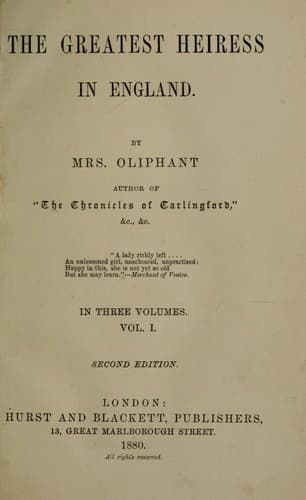
The Greatest Heiress in EnglandOliphant, Mrs. (Margaret)
General
The Greatest Heiress in England
Oliphant, Mrs. (Margaret)
England -- Fiction; Inheritance and succession -- Fiction
arrangement; the “whole thing,” she said to herself, “had gone too far.”
Tom was not prudent; to show his hand to the rest of the guardians at
once, and put them all on their guard, was foolish; and as for waiting
seven years! Lucy might do it; Lucy, who, her maternal guardian thought,
already showed all the signs of being in love; but Tom! he would have a
dozen other serious devotions before that. Sir Tom was fond of platonic
relationships--he did not want to marry, not being able, indeed, to
afford that luxury, yet he liked the gentle excitement of a sentimental
friendship. He liked even to feel himself just going over the edge into
love, yet keeping himself from going over. He had kept himself from
going over so many times, that he knew exactly what twigs to snatch at,
and what eddies to take advantage of; therefore it is not to be supposed
that there could be much danger to him from a simple girl. But certainly
he had gone further than was at all expedient, Lady Randolph’s very
anxiety that this time he should be brought to reason, should not catch
at any twig, but allow himself to be really carried by the current to
the legitimate end, made her unwilling to see matters hurried. Lucy
would make him a very nice little wife, and, if he married, his aunt
knew that he was far too good a fellow not to be a kind husband; but
that Lucy’s simple attractions (even including her fortune, which was a
charm that would never fail) could hold him for seven years, was not a
thing to be hoped for. She spoke to Sir Tom very strongly on the subject
the evening before they separated. Lucy and little Jock--who always was
a troublesome inmate to Lady Randolph because of his very quietness, the
trance of reading, in which she never could be sure that he was not
listening--had gone upstairs early. London was very warm and dusty in
these August days; the windows were open, but the air that came in was
not of a very satisfactory description. Most of the houses were shut up
round about, and in the comparative quiet sounds from the Mews behind
were frequently audible. In short, there was about the district the
uncomfortable feeling that the appropriate inhabitants had gone, and
only a swarm of underground creatures were left, to come forth blinking
from their coverts. In-doors the furniture had all been put into
pinafores, the pretty nothings on the tables had been laid away, the
china locked up in cabinets. Lady Randolph was starting by the morning
mail-train.
“You know, Tom,” she said, “I am not at all sure that it is wise for you
to go down with Lucy to-morrow.”
“Why, aunt? You know it is on my way,” he said, with a twinkle in his
eye.
“Oh, stuff about it being on your way. You know it would not be on your
way at all unless you liked to go.”
“Well!” Sir Thomas said, “and after--” he never indulged in the
vulgarity of French; but he was given to literal translations, which is
more aggravating, and neither one thing nor another, as Lady Randolph
said.
Public-domain text, read in full here on John Shaqi.
Reviews
Reviews
No reviews yet
Be the first to share your thoughts on this work.
Elsewhere in the archive
Join the Discussion
Join the discussion
Sign in to leave a comment or review.
Sign InorCreate an account