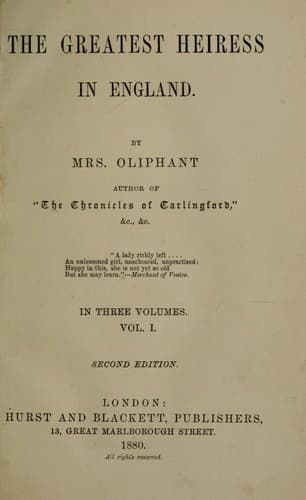
The Greatest Heiress in EnglandOliphant, Mrs. (Margaret)
General
The Greatest Heiress in England
Oliphant, Mrs. (Margaret)
England -- Fiction; Inheritance and succession -- Fiction
Lucy was left alone accordingly, seated in the familiar room, so changed
and transformed, and looking out somewhat drearily upon the common,
which had not changed, which she had crossed so often in those old days
that were never to come back, that could not come back, neither the
simple habits of them, nor the gentle ease of mind and happy ignorance
of everything beyond their quiet round. It was not a cheerful programme
which her present guardian had traced for her, and Lucy, sitting very
still, not caring to move, in the most strangely complete and depressing
solitude which she had ever been conscious of, went further in her
thoughts than Mrs. Ford. Had it all been a mistake? Her father’s
favorite theory, his pet whim about her, his determination to divide her
life between the different worlds of society, one part of it on the
higher level, one on the lower, was that to prove itself at once a
hopeless blunder? Lucy felt too much dulled and stupefied by the sudden
change to be able to think about it; a sensation as of a sudden fall, a
precipitate descent down, down, into a world she no longer understood,
pervaded her being. Lady Randolph’s world had not been a very lofty one;
was it possible that it was the mere external change from one kind of
house to another, from a companion who dressed with exquisite taste to
one who huddled on her common clothes anyhow, and wore crape flowers in
her bonnet; from old, soft, mossy Turkey carpets to brilliant modern
Brussels, that gave her this sensation of downfall? Lucy did not ask
herself the question, nor did it even suggest itself in any formal way
to her mind, only a vague sense of the impossibility of the return, the
radical change in all things, the space she had traversed which could
not be gone back, overwhelmed her vaguely. If it had been a poor country
cottage, a rustic farm-house, real poverty to contrast with the soft
surroundings of wealth, the contrast might have been salutary, and it
might have been natural. But the Terrace was nothing but a vulgar,
unintelligent copy of the house she had come from, the life set before
her now was but a poor imitation of that she had left, but narrowed and
limited and shut in, cut off by jealous precautions from all the human
fellowship that made the other attractive. Ford and his wife, in their
little stuffy parlor, at their teatable, eating their toast and their
shrimps, were as respectable in themselves as Lady Randolph at the head
of the pretty table covered with flowers, softly lighted, and
noiselessly served. Probably they were more honest, more strictly
sincere, than she, and their love for Lucy was a very genuine love, more
profound than her easy affections. But how was it? Lucy could not
tell--to step down all in a moment from Lady Randolph to the Fords was
something incomprehensible and impossible. She could not go back these
six months, the new life had claimed her; she was not capable of
resuming the old where she had left it off.
Public-domain text, read in full here on John Shaqi.
Reviews
Reviews
No reviews yet
Be the first to share your thoughts on this work.
Elsewhere in the archive
Join the Discussion
Join the discussion
Sign in to leave a comment or review.
Sign InorCreate an account