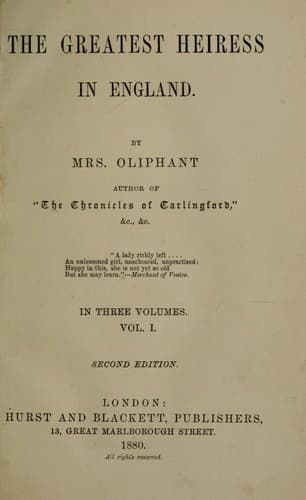
The Greatest Heiress in EnglandOliphant, Mrs. (Margaret)
General
The Greatest Heiress in England
Oliphant, Mrs. (Margaret)
England -- Fiction; Inheritance and succession -- Fiction
It will be seen from all this that Mrs. Ford was but an indifferent
guardian for an heiress. Her ideas of duty were of a peculiar kind. She
had newly furnished the drawing-room. She had sweetbreads and other
dainties for dinner. If Lucy had been fond of cake, or muffins, or
buttered toast, she might have reveled in them; but it did not occur to
the careful housekeeper to give herself much trouble about Lucy’s
visitors. When Mrs. Rushton called, indeed, Mrs. Ford would sail into
the room in her stiffest silk (which she kept spread out upon her bed,
ready to put on at a moment’s notice) and take her part in the
conversation; but she saw the young men come and go with the greatest
indifference, and did not disturb herself out of her usual habits for
them. Though she entertained the worst suspicions in respect to Mrs.
Stone’s motives, she did not object to St. Clair, neither did she
dislike Raymond Rushton, though she saw through (as she thought) all his
mother’s devices. We will not attempt to explain this entirely feminine
reasoning. It was the reasoning of a woman on a lower level of society
than that which considers chaperons necessary. She saw no harm in St.
Clair’s appearance in the morning to teach Jock, though Lucy, not much
better instructed than Mrs. Ford, was always present at the lessons, and
profited too in a mild way. Mr. St. Clair came every morning, turning
the pink drawing-room into a school room, and pursuing his work with so
much conscience that Lucy herself began to learn a little Latin by
listening to Jock’s perpetual repetitions. She was very anxious that
Jock should learn, and consented to hear all the story about the
gentleman and the windmills, in order to bribe him. “I think he must
have been cracked all the same,” Lucy said. “Oh, I don’t say, dear, that
he was not a very nice gentleman; and after you have learned your
lessons, you can tell me a little more.” Mr. St. Clair made himself of
great use to Lucy too. He brought, her books in which she could read her
history at much less cost than in her dry text-books: and helped her on
in a way for which she was unfeignedly grateful. And after the
intercourse of the morning there was the meeting afforded by that
evening stroll in the half light after tea, which Jock considered his
due. Mrs. Stone too loved that evening hour, and the soft dusk and
rising starlight, and was always to be found on the common with her
light Shetland shawl over her handsome head, under the dutiful escort of
her nephew. The two little parties always joined company, and a great
deal of instructive conversation went on. On one of these evenings, Lucy
had been waylaid by a poor creature with a pitiful story which went to
the girl’s heart. It had already become known in Farafield that there
was in the Terrace a young lady who had a great deal of ready money, and
a very soft heart.
Public-domain text, read in full here on John Shaqi.
Reviews
Reviews
No reviews yet
Be the first to share your thoughts on this work.
Elsewhere in the archive
Join the Discussion
Join the discussion
Sign in to leave a comment or review.
Sign InorCreate an account