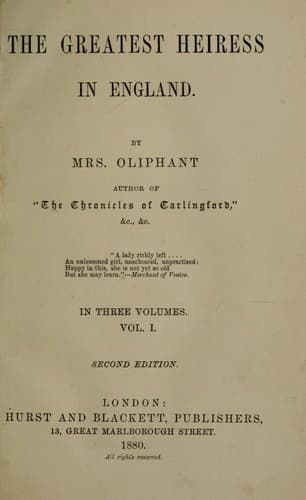
The Greatest Heiress in EnglandOliphant, Mrs. (Margaret)
General
The Greatest Heiress in England
Oliphant, Mrs. (Margaret)
England -- Fiction; Inheritance and succession -- Fiction
“Who was that woman, Lucy?” said Mrs. Stone, as they met at the door of
the White House. They had been standing there, waiting for her, aunt and
nephew both, watching for her coming. “I suppose she was a beggar; but
you must take care not to give too much in that way, or to get yourself
a reputation among them; you will be taken in on every side, and it will
vex you to be deceived.”
“Yes,” said Lucy, simply. “It would vex me very much, more than anything
else I can think of. I would rather be beaten than deceived.”
This made Mrs. Stone wince for a moment, till she reflected that she had
no intention of deceiving Lucy, but, in reality, was trying to bring
about the very best thing for her, the object of every girl’s hopes.
“Then who was this woman?” she said.
“Indeed, I did not ask her name. She was--sent to me. What do you think
is right?” said Lucy, “to give people money, or a little pension, or--”
“A little pension, my dear child! a woman you know nothing about. No,
no, give me her name, and I will have her case inquired into, and if she
is deserving--”
“I don’t think it is anybody that is deserving, Mrs. Stone.”
“Lucy! my dear, you must not--you really _must_ not, act in this
independent way. What do you know about human nature? Nobody who is not
deserving should be allowed to come near a child of your age.”
St. Clair laughed. “That might cut a great many ways,” he said.
“Perhaps, in that case, you would have to banish most of the people Miss
Trevor is in the habit of seeing.”
“You, for example.”
“That was what I was about to suggest,” he said, folding his hands with
an air of great humility. This beguiled Lucy into a smile, as it was
meant to do; and yet there was a certain sincerity in it--a sincerity
which seemed somehow to make up for, and to justify in the culprit’s own
eye, a good deal of deceit; though, indeed, St. Clair said to himself,
like his aunt, that he was using no deceit; he was trying to get the
love of a good and nice girl, one who would make an excellent wife; and
what more entirely warrantable, lawful, laudable action could a young
man do?
“You are making fun,” said Lucy, “but I am in great earnest. Papa, in
his will, ordered me to give away a great deal of money. He did not say
anything about deserving: and if people are in great want, in need--is
it not as hard, almost worse, for the bad people than for the good?”
“My dear, that is very unsafe, very dangerous doctrine. In this way you
would reward the bad for having ruined themselves.”
“Or make up to them,” said St. Clair, “a little--as much as any one can
make up for that greatest of misfortunes--for being bad.”
Lucy looked from one to another, bewildered, not knowing which to
follow.
“Yes, it is the greatest of all misfortunes; but still that is
sophistry; that argument is all wrong. If the good and the bad got just
the same, why should any one be good?”
Public-domain text, read in full here on John Shaqi.
Reviews
Reviews
No reviews yet
Be the first to share your thoughts on this work.
Elsewhere in the archive
Join the Discussion
Join the discussion
Sign in to leave a comment or review.
Sign InorCreate an account