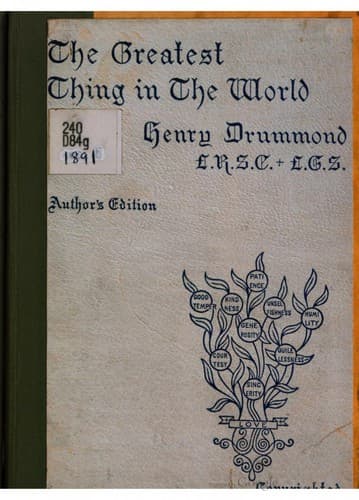
The Greatest Thing In the World and Other AddressesDrummond, Henry
ReligionComparative
The Greatest Thing In the World and Other Addresses
Drummond, Henry
Christian life; Christianity; Love -- Religious aspects
All this is also true of Rest. Restlessness has a cause: must not
_Rest_ have a cause? Necessarily. If it were a chance world we would
not expect this; but, being a methodical world, it cannot be
otherwise. Rest, physical rest, moral rest, spiritual rest, every kind
of rest has a cause, as certainly as restlessness. Now causes are
discriminating. There is one kind of cause for every particular effect
and no other, and if one particular effect is desired, the
corresponding cause must be set in motion. It is no use proposing
finely devised schemes, or going through general pious exercises in
the hope that somehow Rest will come. The Christian life is not
casual, but causal. All nature is a standing protest against the
absurdity of expecting to secure spiritual effects, or any effects,
without the employment of appropriate causes. The Great Teacher dealt
what ought to have been the final blow to this infinite irrelevancy by
a single question, "Do men gather grapes of thorns or figs of
thistles?"
Why, then, did the Great Teacher not educate His followers fully? Why
did He not tell us, for example, how such a thing as Rest might be
obtained? The answer is that _He did_. But plainly, explicitly, in so
many words? Yes, plainly, explicitly, in so many words. He assigned
Rest to its cause, in words with which each of us has been familiar
from his earliest childhood.
He begins, you remember--for you at once know the passage I refer
to--almost as if Rest could be had without any cause; "Come unto me,"
He says, "and I will _give_ you Rest."
Rest, apparently, was a favor to be bestowed; men had but to come to
Him; He would give it to every applicant. But the next sentence takes
that all back. The qualification, indeed, is added instantaneously.
For what the first sentence seemed to give was next thing to an
impossibility. For how, in a literal sense, can Rest be _given_? One
could no more give away Rest than he could give away Laughter. We
speak of "causing" laughter, which we can do; but we can not give it
away. When we speak of "giving" pain, we know perfectly well we can
not give pain away. And when we aim at "giving" pleasure, all that we
do is to arrange a set of circumstances in such a way as that these
shall cause pleasure. Of course there is a sense, and a very wonderful
sense, in which a Great Personality breathes upon all who come within
its influence an abiding peace and trust. Men can be to other men as
the shadow of a great rock in a weary land; much more Christ; much
more Christ as Perfect Man; much more still as Savior of the world.
But it is not this of which I speak. When Christ said He would give
men Rest, He meant simply that He would put them in the way of it. By
no act of conveyance would or could He make over His own Rest to them.
He could give them
HIS RECEIPT
Public-domain text, read in full here on John Shaqi.
Reviews
Reviews
No reviews yet
Be the first to share your thoughts on this work.
Join the Discussion
Join the discussion
Sign in to leave a comment or review.
Sign InorCreate an account