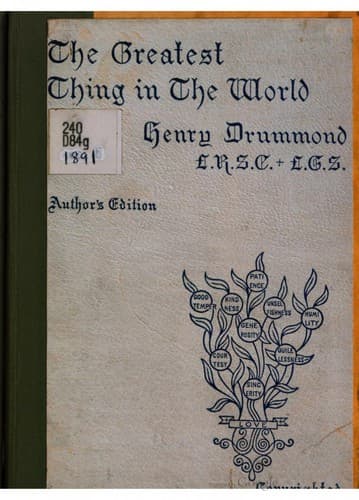
The Greatest Thing In the World and Other AddressesDrummond, Henry
ReligionComparative
The Greatest Thing In the World and Other Addresses
Drummond, Henry
Christian life; Christianity; Love -- Religious aspects
He contrasts it with _eloquence_. And what a noble gift it is, the
power of playing upon the souls and wills of men, and rousing them to
lofty purposes and holy deeds! Paul says, "If I speak with the tongues
of men and of angels, and have not love, I am become sounding brass,
or a tinkling cymbal." We all know why. We have all felt the
brazenness of words without emotion, the hollowness, the unaccountable
unpersuasiveness, of eloquence behind which lies no Love.
He contrasts it with _prophecy_. He contrasts it with _mysteries_. He
contrasts it with _faith_. He contrasts it with _charity_. Why is Love
greater than faith? Because the end is greater than the means. And why
is it greater than charity? Because the whole is greater than the
part.
Love is greater than _faith_, because the end is greater than the
means. What is the use of having faith? It is to connect the soul with
God. And what is the object of connecting man with God? That he may
become like God. But God is Love. Hence Faith, the means, is in order
to Love, the end. Love, therefore, obviously is greater than faith.
"If I have all faith, so as to remove mountains, but have not love, I
am nothing."
It is greater than _charity_, again, because the whole is greater than
a part. Charity is only a little bit of Love, one of the innumerable
avenues of Love, and there may even be, and there is, a great deal of
charity without Love. It is a very easy thing to toss a copper to a
beggar on the street; it is generally an easier thing than not to do
it. Yet Love is just as often in the withholding. We purchase relief
from the sympathetic feelings roused by the spectacle of misery, at
the copper's cost. It is too cheap--too cheap for us, and often too
dear for the beggar. If we really loved him we would either do more
for him, or less. Hence, "If I bestow all my goods to feed the poor,
but have not love it profiteth me nothing."
Then Paul contrasts it with _sacrifice_ and martyrdom: "If I give my
body to be burned, but have not love, it profiteth me nothing."
Missionaries can take nothing greater to the heathen world than the
impress and reflection of the Love of God upon their own character.
That is the universal language. It will take them years to speak in
Chinese, or in the dialects of India. From the day they land, that
language of Love, understood by all, will be pouring forth its
unconscious eloquence.
It is the man who is the missionary, it is not his words. His
character is his message. In the heart of Africa, among the great
Lakes, I have come across black men and women who remembered the only
white man they ever saw before--David Livingstone; and as you cross
his footsteps in that dark continent,
MEN'S FACES LIGHT UP
as they speak of the kind doctor who passed there years ago. They
could not understand him; but they felt the love that beat in his
heart. They knew that it was love, although he spoke no word.
Public-domain text, read in full here on John Shaqi.
Reviews
Reviews
No reviews yet
Be the first to share your thoughts on this work.
Join the Discussion
Join the discussion
Sign in to leave a comment or review.
Sign InorCreate an account