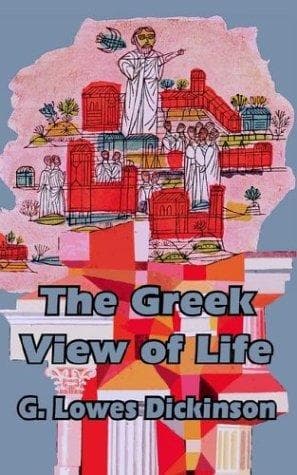
The Greek View of LifeDickinson, G. Lowes (Goldsworthy Lowes)
Religion
The Greek View of Life
Dickinson, G. Lowes (Goldsworthy Lowes)
Greece -- Civilization
We have dwelt thus long on the personality of Socrates, familiar though
it be, not only on account of its intrinsic interest, but also because
it is peculiarly Hellenic. That sunny and frank intelligence, bathed, as
it were, in the open air, a gracious blossom springing from the root of
physical health, that unique and perfect balance of body and soul,
passion and intellect, represent, against the brilliant setting of
Athenian life, the highest achievement of the civilisation of Greece.
The figure of Socrates, no doubt, has been idealised by Plato, but it is
none the less significant of the trend of Hellenic life. No other people
could have conceived such an ideal; no other could have gone so far
towards its realisation.
Section 8. The Greek View of Woman.
In the preceding account we have attempted to give some conception of
the Greek ideal for the individual man. It is now time to remind
ourselves that that ideal was only supposed to be proper to a small
class--the class of soldier-citizens. Artisans and slaves, as we have
seen, had no participation in it; neither, and that is our next point,
had women.
Nothing more profoundly distinguishes the Hellenic from the modern view
of life than the estimate in which women were held by the Greeks. Their
opinion on this point was partly the cause and partly the effect of that
preponderance of the idea of the State on which we have already dwelt,
and from which it followed naturally enough that marriage should be
regarded primarily as a means of producing healthy and efficient
citizens. This view is best illustrated by the institutions of such a
State as Sparta, where, as we saw, the woman was specially trained for
maternity, and connections outside the marriage tie were sanctioned by
custom and opinion, if they were such as were likely to lead to healthy
offspring. Further it may be noted that in almost every State the
exposure of deformed or sickly infants was encouraged by law, the child
being thus regarded, from the beginning, as a member of the State,
rather than as a member of the family.
Public-domain text, read in full here on John Shaqi.
Reviews
Reviews
No reviews yet
Be the first to share your thoughts on this work.
Elsewhere in the archive
Join the Discussion
Join the discussion
Sign in to leave a comment or review.
Sign InorCreate an account