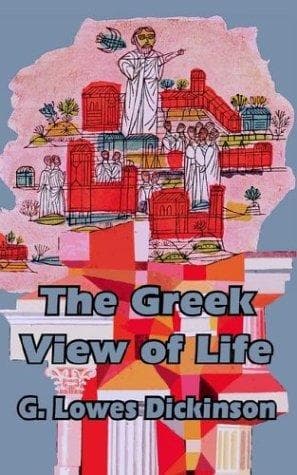
The Greek View of LifeDickinson, G. Lowes (Goldsworthy Lowes)
Religion
The Greek View of Life
Dickinson, G. Lowes (Goldsworthy Lowes)
Greece -- Civilization
the last by a reconciliation of the powers of heaven and hell, and the
pardon of the last offender in the person of Orestes. To sketch,
however, the plan of the other dramas of the trilogy would be to
trespass too far upon our space and time. It is enough to have
illustrated, by the example of the "Agamemnon," the general character of
a Greek tragedy; and those who care to pursue the subject further must
be referred to the text of the plays themselves.
Section 7. Comedy.
Even more remarkable than the tragedy of the Greeks, in its rendering of
a didactic intention under the forms of a free and spontaneous art, is
the older comedy known to us through the works of Aristophanes. As the
former dealt with the general conceptions, religious and ethical, that
underlay the Greek view of life, using as its medium of exposition the
ancient national myths, so the latter dealt with the particular phases
of contemporary life, employing the machinery of a free burlesque. The
achievement of Aristophanes, in fact, is more astonishing, in a sense,
than that of Aeschylus. Starting with what is always, _prima
facie_, the prose of everyday life, its acrid controversies, its
vulgar and tedious types, and even its particular individuals--for
Aristophanes does not hesitate to introduce his contemporaries in person
on the stage--he fits to this gross and heavy stuff the wings of
imagination, scatters from it the clinging mists of banality and spite
and speeds it forth through the lucid heaven of art amid peals of
musical laughter and snatches of lyric song. For Aristophanes was a poet
as well as a comedian, and his genius is displayed not only in the
construction of his fantastic plots, not only in the inexhaustible
profusion of his humane and genial wit, but in bursts of pure poetry as
melodious and inspired as ever sprang from the lips of the lyrists of
Greece or of the world. The basis of the comic as of the tragic art of
the Greeks was song and dance; and the chorus, the original element of
the play, still retains in the works of Aristophanes a place important
enough to make it clear that in comedy, too, a prominent aspect of the
art must have been the aesthetic appeal to the ear and the eye. In
general structure, in fact, comedy and tragedy were alike; aesthetically
the motives were similar, only they were set in a different key.
But while primarily Aristophanes, like the tragedians, was a great
artist, he was also, like them, a great interpreter of life. His dramas
are satires as well as poems, and he was and expressed himself supremely
conscious of having a "mission" to fulfil. "He has scorned from the
first," he makes the chorus sing of himself in the "Peace":
Public-domain text, read in full here on John Shaqi.
Reviews
Reviews
No reviews yet
Be the first to share your thoughts on this work.
Elsewhere in the archive
Join the Discussion
Join the discussion
Sign in to leave a comment or review.
Sign InorCreate an account