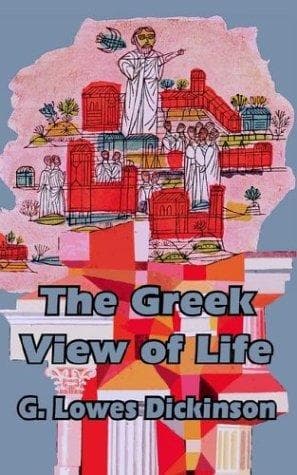
The Greek View of LifeDickinson, G. Lowes (Goldsworthy Lowes)
Religion
The Greek View of Life
Dickinson, G. Lowes (Goldsworthy Lowes)
Greece -- Civilization
Of all the problems on which we expect light to be thrown by religion
none, to us, is more pressing than that of death. A fundamental, and as
many believe, the most essential part of Christianity, is its doctrine
of reward and punishment in the world beyond; and a religion which had
nothing at all to say about this great enigma we should hardly feel to
be a religion at all. And certainly on this head the Greeks, more than
any people that ever lived, must have required a consolation and a hope.
Just in proportion as their life was fuller and richer than that which
has been lived by any other race, just in proportion as their capacity
for enjoyment, in body and soul, was keener, as their senses were finer,
their intellect broader, their passions more intense, must they have
felt, with peculiar emphasis, the horror of decay and death. And such,
in fact, is the characteristic note of their utterances on this theme.
"Rather," says the ghost of Achilles to Odysseus in the world of shades,
"rather would I live upon the soil as the hireling of another, with a
landless man who had no great livelihood, than bear sway among all the
dead that are no more." [Footnote: Od. xi 489.--Translated by Butcher
and Lang.] Better, as Shakespeare has it,
"The weariest and most loathed worldly life
That age, ache, penury and imprisonment
Can lay on nature,"
better that, on earth at least and in the sun, than the phantom kingdoms
of the dead. The fear of age and death is the shadow of the love of
life; and on no people has it fallen with more horror than on the
Greeks. The tenderest of their songs of love close with a sob; and it is
an autumn wind that rustles in their bowers of spring. Here, for
example, is a poem by Mimnermus characteristic of this mood of the
Greeks:
"O golden Love, what life, what joy but thine?
Come death, when thou art gone, and make an end!
When gifts and tokens are no longer mine,
Nor the sweet intimacies of a friend.
These are the flowers of youth. But painful age
The bane of beauty, following swiftly on,
Wearies the heart of man with sad presage
And takes away his pleasure in the sun.
Hateful is he to maiden and to boy
And fashioned by the gods for our annoy."
[Footnote: Mimnermus, El. I.]
Such being the general view of the Greeks on the subject of death, what
has their religion to say by way of consolation? It taught, to begin
with, that the spirit does survive after death. But this survival, as it
is described in the Homeric poems, is merely that of a phantom and a
shade, a bloodless and colourless duplicate of the man as he lived on
earth. Listen to the account Odysseus gives of his meeting with his
mother's ghost.
Public-domain text, read in full here on John Shaqi.
Reviews
Reviews
No reviews yet
Be the first to share your thoughts on this work.
Join the Discussion
Join the discussion
Sign in to leave a comment or review.
Sign InorCreate an account