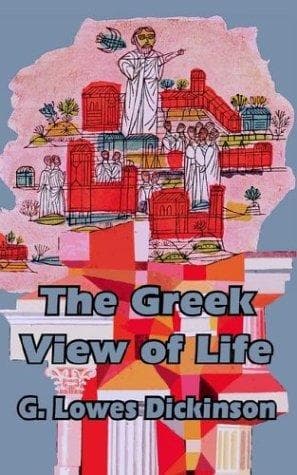
The Greek View of LifeDickinson, G. Lowes (Goldsworthy Lowes)
Religion
The Greek View of Life
Dickinson, G. Lowes (Goldsworthy Lowes)
Greece -- Civilization
This little prosaic account of the daily life of an Athenian gentleman
is completely in harmony with all we have said about the character of
the Greek ideal; but it comprehends only a part, and that the least
spiritual, of that rich and many-sided excellence. It may be as well,
therefore, to append by way of complement the description of another
personality, exceptional indeed even among the Greeks, yet one which
only Greece could have produced--the personality of Socrates. No more
striking figure is presented to us in history, none has been more
vividly portrayed, and none, in spite of the originality of mind which
provoked the hostility of the crowd, is more thoroughly Hellenic in
every aspect, physical, intellectual, and moral.
That Socrates was ugly in countenance was a defect which a Greek could
not fail to note, and his snub nose and big belly are matters of
frequent and jocose allusion. But apart from these defects his physique,
it appears, was exceptionally good; he was sedulous in his attendance at
the gymnasia, and was noted for his powers of endurance and his courage
and skill in war. Plato records it of him that in a hard winter on
campaign, when the common soldiers were muffling themselves in
sheepskins and felt against the cold, he alone went about in his
ordinary cloak, and barefoot over the ice and snow; and he further
describes his bearing in a retreat from a lost battle, how "there you
might see him, just as he is in the streets of Athens, stalking like a
pelican and rolling his eyes, calmly contemplating enemies as well as
friends, and making very intelligible to anybody, even from a distance,
that whoever attacked him would be likely to meet with a stout
resistance." [Footnote: Plato, Symp. 221 b.--Translated by Jowett.]
To this efficiency of body corresponded, in accordance with the Greek
ideal, a perfect balance and harmony of soul. Plato, in a fine figure,
compares him to the wooden statues of Silenus, which concealed behind a
grotesque exterior beautiful golden images of the gods. Of these divine
forms none was fairer in Socrates than that typical Greek virtue,
temperance. Without a touch of asceticism, he knew how to be contented
with a little. His diet he measured strictly with a view to health.
Naturally abstemious, he could drink, when he chose, more than another
man; but no one had ever seen him drunk. His affections were strong and
deep, but never led him away to seek his own gratification at the cost
of those he loved. Without cutting himself off from any of the pleasures
of life, a social man and a frequent guest at feasts, he preserved
without an effort the supremacy of character and mind over the flesh he
neither starved nor pampered. Here is a description by Plato of his
bearing at the close of an all-night carouse, which may stand as a
concrete illustration not only of the character of Socrates, but of the
meaning of "temperance" as it was understood by the Greeks:
Public-domain text, read in full here on John Shaqi.
Reviews
Reviews
No reviews yet
Be the first to share your thoughts on this work.
Elsewhere in the archive
Join the Discussion
Join the discussion
Sign in to leave a comment or review.
Sign InorCreate an account