Jewish philosophy -- Early works to 1800; Judaism -- Works to 1900; Philosophy, Medieval -- Early works to 1800
My primary object in this work is to explain certain words occurring in
the prophetic books. Of these some are homonyms, and of their several
meanings the ignorant choose the wrong ones; other terms which are
employed in a figurative sense are erroneously taken by such persons in
their primary signification. There are also hybrid terms, denoting
things which are of the same class from one point of view and of a
different class from another. It is not here intended to explain all
these expressions to the unlettered or to mere tyros, a previous
knowledge of Logic and Natural Philosophy being indispensable, or to
those who confine their attention to the study of our holy Law, I mean
the study of the canonical law alone; for the true knowledge of the
Torah is the special aim of this and similar works.
The object of this treatise is to enlighten a religious man who has
been trained to believe in the truth of our holy Law, who
conscientiously fulfils his moral and religious duties, and at the same
time has been successful in his philosophical studies. Human reason has
attracted him to abide within its sphere; and he finds it difficult to
accept as correct the teaching based on the literal interpretation of
the Law, and especially that which he himself or others derived from
those homonymous, metaphorical, or hybrid expressions. Hence he is lost
in perplexity and anxiety. If he be guided solely by reason, and
renounce his previous views which are based on those expressions, he
would consider that he had rejected the fundamental principles of the
Law; and even if he retains the opinions which were derived from those
expressions, and if, instead of following his reason, he abandon its
guidance altogether, it would still appear that his religious
convictions had suffered loss and injury. For he would then be left
with those errors which give rise to fear and anxiety, constant grief
and great perplexity.
This work has also a second object in view. It seeks to explain certain
obscure figures which occur in the Prophets, and are not distinctly
characterized as being figures. Ignorant and superficial readers take
them in a literal, not in a figurative sense. Even well informed
persons are bewildered if they understand these passages in their
literal signification, but they are entirely relieved of their
perplexity when we explain the figure, or merely suggest that the terms
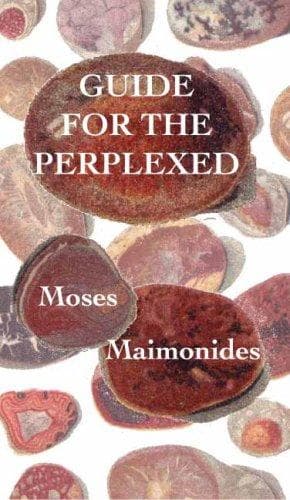
are figurative. For this reason I have called this book Guide for the
Perplexed.
Public-domain text, read in full here on John Shaqi.
Reviews
Reviews
No reviews yet
Be the first to share your thoughts on this work.
Join the Discussion
Join the discussion
Sign in to leave a comment or review.
Sign InorCreate an account