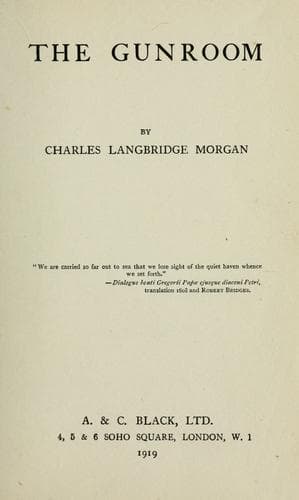
Great Britain. Royal Navy -- Fiction; Seafaring life -- Fiction
The outlines of his vision of her were thus sharpened. Now that she and
his hopes for the future were at once taken away from him he saw her as
he had never seen her before. Her personality stood out more clearly.
A new fierceness and impatience entered into his thoughts of her. That
the worldly difficulties in the way of his claiming her were as great
as ever mattered no longer. That he was still a midshipman mattered not
at all. There was no denying now that he loved her--that fact dominated
all others, sweeping aside doubts, and arguments, and misgivings.
For a time this singleness of purpose was a source of happiness, a
stimulant, the effects of which rapidly passed away. At last John went
to Hartington, and showed him the fateful letter.
“Well,” Hartington said, “what are you going to do?”
“It’s definitely the end,” John answered. “It’s no good to go on hoping
to leave the Service. I’d better settle down to it, I suppose.”
“What are you going to say to your mother?”
“Oh, some lie. I don’t want her to worry her soul out. Better make
her believe I’ve changed my mind. How does one change one’s mind
convincingly?”
Together they planned his reply.
“It’s all very well for me to say I will settle down,” John said, “but
there’s no incentive in this job. I shall always look outside it. And
yet, God knows, I shall take it lying down like the rest of them:
grumble and grouse, but never break free, never rebel. Isn’t it odd
how one submits and submits, until at last the average N.O. begins to
believe, ‘Oh well, it isn’t so bad, after all’?”
“Even the cabhorse gets accustomed to his cab--perhaps gets to like it
in the end.”
John answered: “I begin to see the wisdom of breaking snotties while
they are young. I suppose it’s kinder in the long run.”
II
As autumn drew on to winter, the cold of Northern China closed down
on Wei-hai-wei, and, after a short cruise to Ching-Wang-Tao, the
_Pathshire_ lay in harbour until Christmas-time. John saw little of
Margaret, and never saw her alone. To meet her now was an exquisite
agony, for her beauty, of which he seemed never before to have been
fully aware, had that amazing power to baffle and astonish which is
the attribute of ghosts. For him the former Margaret still existed,
but under a cloak of unreality. Her friendly smile, her deep, quiet
eyes, that reflected laughter as a great lake reflects the lamps
swinging on the boats of _fête_, her manner of giving him her hand, of
inclining her body a little backwards as she spoke, these things were
familiar with the familiarity of a persistent memory--in the light of
circumstance they were no more substantial than this.
Public-domain text, read in full here on John Shaqi.
Reviews
Reviews
No reviews yet
Be the first to share your thoughts on this work.
Elsewhere in the archive
Join the Discussion
Join the discussion
Sign in to leave a comment or review.
Sign InorCreate an account