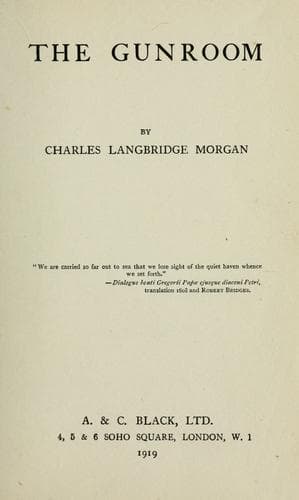
Great Britain. Royal Navy -- Fiction; Seafaring life -- Fiction
“You’re very deep in that book, Margaret,” Hugh said, as he passed her.
“Aren’t you coming out?”
“I want to finish it before lunch. Do you mind?”
“I see the last of you and mother to-morrow.”
“I’ll come this afternoon, ... or shall I come now?”
He looked into her upturned face. Her hand was on the arm of her chair
to raise herself.
“No, you odd sister.... No; you’re not to come--of course not.”
She went late to lunch, and was surprised to find Hartington at her
mother’s table, with John and Hugh. He said that his leave lasted only
till that evening.
“Can’t you stay and go back with us to-morrow?” Hugh asked.
“No.” He shook his head. “But I wanted to see the homeward goers before
they went. That’s really all I came for.”
The meal over, he had no difficulty in seeing Margaret alone, for she
felt that it was to see her he had come.
“Well,” she said, “secret emissary, what is it?”
“You know there’s something?”
“You are full of suppressed news.”
“Yes; good news--oh, such good news!”
“Thank God for that!” she breathed.
“You expected bad?”
“I fear it always. There’s nothing definite that I expect. But
somehow----”
“No,” he said quickly. “This is good, anyhow. Lynwood is free--through
Wingfield Alter.”
She gave no sign of pleasure so eager was she. “How? Really free?”
“Really free,” he smiled. “Are you beginning to disbelieve in
freedom?... The mail came in after Lynwood left the ship. A letter for
him from his mother, and a letter for me from Alter. I have them both
here. Alter is to marry Mrs. Lynwood. He has taken the first definite
step towards getting Lynwood out of the Service.”
“When will he be free? Will he come home with us?”
“Not possible. It takes time. But now it is only a question of time--a
couple of months, perhaps.”
“You haven’t given him his mother’s letter?”
“No.”
“You haven’t told him?”
“No; I came to you first. I want you to tell him.”
Something stifled her inclination to ask “Why?”
Hartington went on hesitatingly: “It means so much to him, you see.
It’s such tremendous news, because he has no hope or expectation of it.
So ... Miss Fane-Herbert, I want you to tell him.”
Her eyes widened for a moment. They looked out beyond Hartington. Then,
with abrupt decision, she said, with a fluttering, pleading gesture
towards him: “No; you. You must tell him. It’s your right. You brought
it about.”
“I wrote to Alter--that’s all.”
“It came about through you. Oh, long before the writing of that
letter, you helped him--didn’t you?--perhaps not deliberately. You
don’t realize how much you have done for him. Certainly you don’t
realize what he feels for you--the strangest mixture of affection, and
admiration, and respect--but overwhelming. You are all that’s best in
men for him! And he’d like you to bring this news. He’ll be glad, years
on, that it was you who brought it. Friendship between men is so much
more substantial, more secure. You must tell him,” she concluded. “It’s
your right.”
Public-domain text, read in full here on John Shaqi.
Reviews
Reviews
No reviews yet
Be the first to share your thoughts on this work.
Elsewhere in the archive
Join the Discussion
Join the discussion
Sign in to leave a comment or review.
Sign InorCreate an account