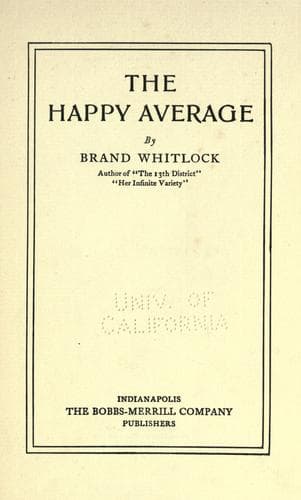
Betrothal -- Fiction; Courtship -- Fiction; Middle West -- Fiction; United States -- Social life and customs -- Fiction
Wade Powell, sitting with his feet on his table, held his newspaper
aside and looked at Marley over his spectacles. Marley had had an ideal
of Wade Powell, and now he had to pause long enough to relinquish the
ideal and adjust himself to the reality. The hair was as disordered as
his young fancy would have had it, but it was thinner than he had known
it in his dreams, and its black was streaked with gray. The face was
smooth-shaven, which accorded with his notion, though it had not been
shaven as recently as he felt it should have been. But he could not
reconcile himself to the spectacles that rested on Powell's nose, and
pressed their bows into the flesh of his temples--the eagle eyes of the
Wade Powell of his imagination had never known glasses.
When Wade Powell slowly pulled his spectacles from his nose and tossed
them on to the table before him, he bent his eyes on Marley, and their
gaze, under their heavy brows, somewhat restored him, but it could not
atone for the disappointment. Perhaps the disappointment that Marley
felt in this moment came from some dim, unrealized sense that Wade
Powell was growing old. The spectacles, the gray in his hair, the
wrinkles in his face, the looseness of the skin at his jaws and at his
throat--where a fold of it hung between the points of his collar--all
told that Wade Powell had passed the invisible line which marks life's
summit, and that his face was turned now toward the evening. There was
the touch of sadness in the indistinct conception of him as a man who
had not altogether realized the ambitions of his youth or the
predictions of his friends, and the sadness came from the intuition that
the failure or the half-failure was not of the heroic kind.
The office in which he sat, and on which, in the long years, he had
impressed his character, was untidy; the floor was dirty, the books on
the shelves were dusty and leaning all awry; the set of the Ohio reports
had not been kept up to date; one might have told by a study of them at
just what period enterprise and energy had faltered, while the gaps here
and there showed how an uncalculating generosity had helped a natural
indolence by lending indiscriminately to other lawyers, who, with the
lack of respect for the moral of the laws they pretended to revere, had
borrowed with no thought of returning.
Public-domain text, read in full here on John Shaqi.
Reviews
Reviews
No reviews yet
Be the first to share your thoughts on this work.
Join the Discussion
Join the discussion
Sign in to leave a comment or review.
Sign InorCreate an account