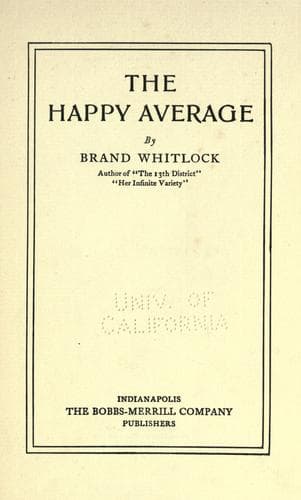
Betrothal -- Fiction; Courtship -- Fiction; Middle West -- Fiction; United States -- Social life and customs -- Fiction
"Let's go in."
All that day Marley went about faltering over his preparations. Wade
Powell was the only one of the few who were interested in him that was
enthusiastic over his going, and he praised and congratulated him, and
pierced his already sore heart by declaring that he had known all along
it was what Marley would be compelled to do. He would give him a letter
to his old friend, Judge Johnson, he said; the judge would be a great
man for him to know, and Powell sat down at once, with more energy and
enterprise than Marley had ever known him to show, and began to
elaborate his letter of introduction.
Marley dreaded saying good-by; he wished to shirk it as to Powell as he
intended to shirk it in the cases of his few friends; he was to return
to the office a last time in the afternoon to get the letter; and then
he would bid Powell good-by. He had the day before him, but that thought
could give him no comfort. He would see Lavinia again in the afternoon;
he would see her once more, for the last time, in the evening, and in
the meantime he would see his father and his mother, and his home; he
had still two meals to eat with them, but it was as if he had already
gone; there was no reality in his presence there among them; the blow
that fate had decreed had fallen, and all that was to be was then
actually in being; all about him the men and women of Macochee were
pursuing their ordinary occupations just as if he were not so soon to go
away and be of this scene no more; a few hours, and another day, and
they would be going on with their concerns just the same, and he would
have disappeared out of their lives and out of their memories.
He looked at everything that had been associated with his life, and
everything called up some memory,--the little office where he had tried
to study law, the Court House, and the blind goddess of justice holding
aloft her scales, the familiar Square, the cloaked cavalryman on the
monument, every tree, every fence, every brick in the sidewalk somehow
called out to him--and he was leaving them all. He looked up and down
Main Street, wide and ugly, littered with refuse, ragged with its
graceless signs; he thought of the people who had gossiped about him,
the people whom he had hated, but now he could not find in his heart the
satisfaction he had expected in leaving them. He felt tenderly, almost
affectionately, toward them all. But it was worse at home. He wandered
about the house, looking at every piece of furniture, at every trinket;
he went into the woodshed, and the old ax, the old saw, everything he
had known for years, wrung his heart; he went to the barn, he looked at
the muddy buggy in which he had driven so often with his father; he
reproached himself because he had not kept the buggy cleaner for him; he
went into the stall and patted the flank of Dolly, finally he put his
arms about her warm neck, laid his face against it, and the tears rolled
down his cheeks.
Public-domain text, read in full here on John Shaqi.
Reviews
Reviews
No reviews yet
Be the first to share your thoughts on this work.
Elsewhere in the archive
Join the Discussion
Join the discussion
Sign in to leave a comment or review.
Sign InorCreate an account