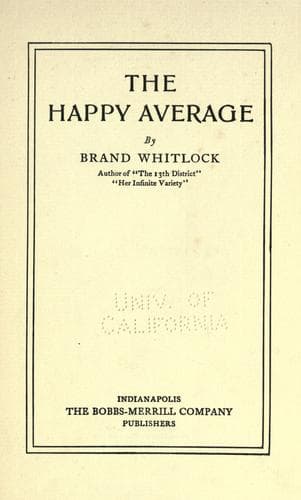
Betrothal -- Fiction; Courtship -- Fiction; Middle West -- Fiction; United States -- Social life and customs -- Fiction
One of the preachers that were always dropping in on them was there to
dinner, and in the blessing he invoked on the temporalities, as he
called them, he prayed with professional unction for the son who was
about to leave the old roof-tree, and this made the ordeal harder for
them all. Doctor Marley spoke to the preacher of little things that he
was to do within the next few days and Marley wondered how he could
mention them, for they were to be done at a time when he would be there
no more. Because he conceived of life, as all must conceive of it,
solely in its relation to himself, he could not imagine life going on in
Macochee without him.
The afternoon wore on, he passed his hour with Lavinia; they were to
meet then but once again; he returned home, his mother had packed his
trunk; it was waiting. He was tender with his mother, and he wondered
now, with a wild regret, why he had not always been tender with her; he
was tender now with all things; a tenderness suffused his whole being;
it seemed as if it might dissolve in tears.
Still he shrank back; there was one thing more to do; he was to go
up-town and get his ticket, and the letter to Judge Johnson, and bid
Wade Powell good-by. A wild hope leaped in his heart; perhaps--but no,
it was irrevocable now. He went, and got his letter, but Powell refused
to bid him good-by; he said he would be at the train to see him off. He
bought his ticket and went home. Old man Downing had been there with his
dray and hauled away his trunk; it was settled. He could only wait and
watch the minutes tick by.
It seemed to Marley that all things that evening conspired to accentuate
all that he was leaving behind, and to make the grief of parting more
poignant. His mother, who was then in that domestic exigency described
by the ladies of Macochee as being without a girl, had prepared an
unusually elaborate supper, and while there was no formal observance of
the fact, it was eaten, so far as any of them could eat that evening,
under a sense of its significance as a parting ceremonial. They talked,
or tried to talk, indifferently of commonplace things, and Doctor Marley
even sought to add merriment to their feast by a jocularity that was
unusual with him. Marley, who knew his father so well, could easily
detect the heavy heart that lay under his father's jokes, and he
suffered a keener misery from the pathos of it. Then he would catch his
mother looking at him, her eyes deep and sad, and it seemed to him that
his heart must burst.
Public-domain text, read in full here on John Shaqi.
Reviews
Reviews
No reviews yet
Be the first to share your thoughts on this work.
Elsewhere in the archive
Join the Discussion
Join the discussion
Sign in to leave a comment or review.
Sign InorCreate an account