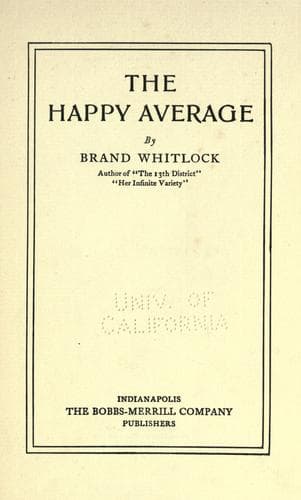
Betrothal -- Fiction; Courtship -- Fiction; Middle West -- Fiction; United States -- Social life and customs -- Fiction
Marley's train was to leave at eleven o'clock; he had arranged to go to
Lavinia's and remain with her until ten o'clock; then he was to stop in
at his home for his last good-by. Those last two hours with Lavinia were
an ordeal; into the first hour they tried to crowd a thousand things
they felt they must say, and a thousand things they could only suggest;
when the clock struck nine, they looked at each other in anguish; they
did little after that but mentally count the minutes. The clock ticked
loudly, aggressively, until in the soul of each, unconfessed, there was
a desire to hasten the moments they felt they would like to stay; the
agony was almost beyond endurance; it exhausted them, beat them down,
and rendered them powerless to speak. Finally the clock struck the
half-hour; they could only sit and look at each other now; at a quarter
of ten they began their good-bys.
At ten o'clock Mrs. Blair, Connie and Chad came into the room solemnly,
and bade Marley farewell; the judge himself came in after them, his
glasses in his hand and the magazine he had been reading, which, as
Marley thought with that pang of things going on without him, he would
in a few moments be reading again as calmly as ever. He took Marley's
hand, and wished him success; for the first time he spoke gently, almost
affectionately to him, and although Marley tried to bear himself
stoically, the judge's farewell touched him more than all the others.
The shameless children would have liked to remain and see the tragedy to
its close, but Mrs. Blair drew them from the room with her. The last
moment had come, and Marley held Lavinia in his arms; at last he tore
himself from her, and it was over. He looked back from out the darkness;
Lavinia was still standing in the doorway; he saw her slender, girlish
figure outlined against the hall light behind her; somehow he knew that
she was bravely smiling through her tears. She stood there until his
footfall sounded loud in the spring night, then the light went out, the
door closed as he had heard it close so often, and she was gone.
He saw the light in his father's study as he approached his home, and
there came again that torturing sense: the sermon his father then was
working on would be preached when he was far away; his mother, as he
knew by the light in the sitting-room window, was waiting for him; she
had waited there so many nights, and now she was waiting for the last
time. She rose at his step, and took him to her arms the minute he
entered the door.
"Be brave, dear," he said, stroking her gray hair; "be brave." He was
trying so hard to be brave himself, and she was crying. He had not often
seen her cry. She could not speak for many minutes; she could only pat
him on the shoulder where her head lay.
"Remember, my precious boy," she managed to say at last, "that there's a
strong Arm to lean upon."
Public-domain text, read in full here on John Shaqi.
Reviews
Reviews
No reviews yet
Be the first to share your thoughts on this work.
Elsewhere in the archive
Join the Discussion
Join the discussion
Sign in to leave a comment or review.
Sign InorCreate an account