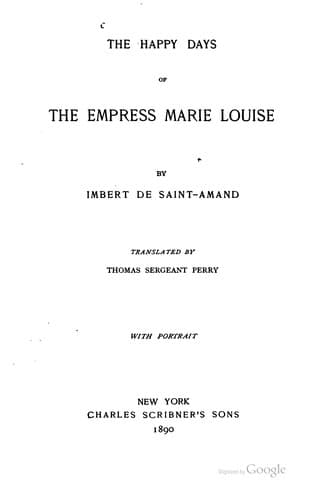
The Happy Days of the Empress Marie LouiseImbert de Saint-Amand
History
The Happy Days of the Empress Marie Louise
Imbert de Saint-Amand
Marie Louise, Empress, consort of Napoleon I, Emperor of the French, 1791-1847
The entertainment given to the Emperor and Empress by the city of Paris,
June 10, was magnificent. There were great rejoicings in the capital
on that day. In the afternoon there were public sports in the Champs
Élysées, and dancing in the open places and the long walks. With
nightfall the illuminations began. A troupe of mountebanks performed
on a huge stage a ballet in pantomime, called the "Union of Mars and
Flora." There were as many as five hundred performers. There were bands
playing in every direction, and food was distributed to the contented
multitude. From the Arc to the Tuileries, from the Tuileries to the
Louvre, from the Louvre to the Hôtel de Ville, the spectacle was really
fairy-like. Napoleon and Marie Louise, starting from Saint Cloud at
eight in the evening, made their way, in torchlight, through a countless
multitude. Their approach was announced to the people by the sudden
ascent of a balloon, from which fireworks were discharged. At half-past
nine they reached the Hôtel de Ville. Nearly a thousand persons had
gathered in the concert hall, almost three thousand in the record room,
the Hall of Saint John, and in the semicircular place in front, opposite
the spot, on the left bank of the Seine, where the fireworks were to be
set off at a signal of Napoleon and Marie Louise. These fireworks were
divided into three parts, representing a military scene, the Temple of
Peace, and the Temple of Hymen. In the first there were two forts which
soldiers were assaulting, firing their guns amid the sound of trumpets
and the rattle of drums. The forts were discharging shells and bullets,
which burst into flame, and were reflected in the water before they fell
into the river. When the two forts were captured, they disappeared in a
great blaze. Then the ship, the symbol of the city of Paris, appeared
and took its station between two columns of light. The decoration
changed, and first the Temple of Peace was seen, then that of
Hymen--a real pyrotechnic masterpiece. After the fireworks the Emperor
and Empress went first into the record room, then into the concert hall,
where was sung a cantata, with words by Arnault and music by Méhul,
which began with this apostrophe to the Empress:--
"From the throne where our homage rises to you,
From the throne where beauty reigns by the side of courage,
And Minerva by the side of Mars,
On these shores of which love has made you sovereign,
On these happy shores adorned by the Seine,
Louise, cast thy glance."
Public-domain text, read in full here on John Shaqi.
Reviews
Reviews
No reviews yet
Be the first to share your thoughts on this work.
Elsewhere in the archive
Join the Discussion
Join the discussion
Sign in to leave a comment or review.
Sign InorCreate an account