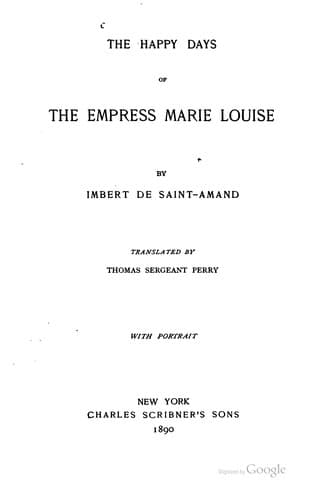
The Happy Days of the Empress Marie LouiseImbert de Saint-Amand
History
The Happy Days of the Empress Marie Louise
Imbert de Saint-Amand
Marie Louise, Empress, consort of Napoleon I, Emperor of the French, 1791-1847
After the cantata a ball began. Napoleon did not dance, but Marie Louise
did. The first quadrille was thus made up: the Empress and the King
of Westphalia, the Queen of Naples and the Viceroy of Italy, Princess
Pauline Borghese and Prince Esterhazy, Mademoiselle de Saint-Gilles and
M. de Nicolaï. The second quadrille: the Queen of Westphalia and Prince
Borghese, the Princess of Baden and Count Metternich, the Princess
Aldobrandini and M. de Montaran, Madame Blaque de Belair and M. Mallet.
The Emperor descended from his throne and walked through the room,
exchanging a few words with a great many people. About midnight he
withdrew with the Empress. At two o'clock supper was served: at this
fifteen hundred ladies were present, and the ball went on till daybreak.
Princess Pauline Borghese gave a very brilliant entertainment June 14,
at the castle of Neuilly. At the end of an illuminated lawn appeared
the Austrian palace of Laxenburg, and the ballet consisted of dancers
arrayed like peasants of the neighborhood of Vienna. June 21, another
great ball was given by the Duke of Feltre, the Minister of War. But
the finest, the most original, the grandest ball, was that given by the
Imperial Guard at the Champ de Mars and the Military School, at that
time called the Napoleon quarter. Marie Louise was thoroughly delighted
with it; she said she had never seen anything so magnificent. Never had
Rome under the Caesars seen a more gorgeous spectacle. For many months
the public had been watching the vast preparations for this event. Two
wings had been added to the Military School, large enough to hold eight
thousand persons. The main courtyard had been transformed into a garden
in which were set out numberless orange-trees, shrubs, and flowers. The
officers of the Guard, who were models of French politeness, received
the ladies at the entrance of this garden, offering each one a
bouquet, and escorted them to the galleries which led to the two newly
constructed buildings, one of which was the ball-room; the other, the
supper-room. The ball-room was shaped like a tent, and the ceiling was
decorated with the signs of the Zodiac and allegorical representation of
a triumph. A throne was set there, above seven rows of seats. All around
the room hung muslin draperies, on which were embroidered gold bees and
branches of myrtle and laurel. When the Emperor and Empress appeared at
seven o'clock, three thousand women, each with a bouquet in her hand,
rose at once. It seemed like a living flower-garden. The wives of the
most illustrious officers of the Guard, the Duchess of Dalmatia, of
Treviso, of Istria, Countess Walter, Dorsenne, Curial, Saint-Sulpice,
Lefebore, Desnonettes, Krasenska, Baronesses Kirgener, Lubenska, Guiot,
Gros, Delaistre and Lepic, had been chosen to escort the Empress.
Marshal Bessières, Duke of Istria, presented her with a magnificent
bouquet.
Public-domain text, read in full here on John Shaqi.
Reviews
Reviews
No reviews yet
Be the first to share your thoughts on this work.
Elsewhere in the archive
Join the Discussion
Join the discussion
Sign in to leave a comment or review.
Sign InorCreate an account