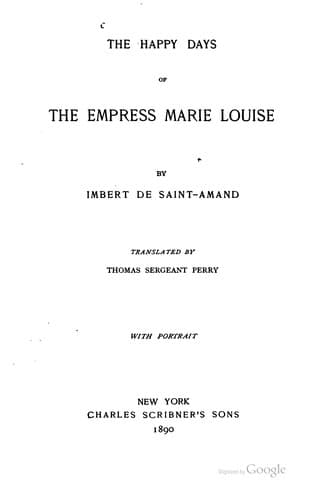
The Happy Days of the Empress Marie LouiseImbert de Saint-Amand
History
The Happy Days of the Empress Marie Louise
Imbert de Saint-Amand
Marie Louise, Empress, consort of Napoleon I, Emperor of the French, 1791-1847
The series of grand entertainments which had been given in Paris was
to be concluded by a ball, which Prince Schwarzenberg, the Austrian
Ambassador, was to give at the Embassy, July 1, 1810, to the Emperor and
Empress; it had been announced that this was to be a marvel of luxury,
elegance, and good taste. The Ambassador lived in the rue de la
Chaussée d'Antin, in a mansion formerly belonging to the Marchioness
of Montesson, widow of the Duke of Orleans, to whom this lady had been
united by a morganatic marriage. Great preparations had been made with
extraordinary magnificence. Since the ground floor of the house was too
small, a large ball-room of wood had been built, reached by a gallery,
also of wood, leading from the body of the house. The ceiling of this
gallery was covered with varnished paper, decorated and painted; the
floor-boards, which were supported on a framework, were raised to the
same height as the floors of the house. A large chandelier hung from the
ceiling of the ball-room. The sides and the circuit of the gallery were
lit by candelabra fastened to the walls. A high platform was reserved
for the Imperial family, in the centre of the right-hand side of the
ball-room, directly opposite a large door opening on the garden.
Behind the platform was a small door reserved for the sovereigns.
The Ambassador and his wife had staying with them his brother and
sister-in-law, Prince Joseph and Princess Pauline Schwarzenberg, who
were to help him in doing the honors of the ball.
Napoleon and Marie Louise, who started from Saint Cloud, reached the
gates of Paris at quarter to ten; there they got into another carriage,
and soon after ten were at the door of the Embassy, where the Ambassador
received them. The Emperor wore over his coat the broad Austrian ribbon
of Saint Stephen.
The grand ball was opened; a troupe of musicians in the court of honor
sounded a flourish of trumpets at the entrance of Their Majesties, who
passed through the concert hall into the garden, where they stopped a
moment before the Temple of Apollo. There women, dressed to resemble the
Muses, sang a joyous chorus. Napoleon and Marie Louise passed slowly
along a water-walk, where hidden music issued from a subterranean
grotto, to a vine-clad arbor adorned with mirrors, monograms, flowers,
and wreaths, and listened to a concert of vocal and instrumental music,
French and German; then they went further into the garden, stopping
before a Temple of Glory, where were four handsome women representing
Victory, the muse Clio, and Renown; then trumpets sounded, triumphal
songs were sung, and perfumes were burning on golden tripods. Then they
turned to see a delightful ballet danced on the greensward, with a view
of the Palace of Laxenburg--so dear to Marie Louise--in the background;
that done, they entered the wooden gallery just put up before the front
of the mansion, and finally entered the ball-room, which was large
enough to hold about fifteen hundred people.
Public-domain text, read in full here on John Shaqi.
Reviews
Reviews
No reviews yet
Be the first to share your thoughts on this work.
Elsewhere in the archive
Join the Discussion
Join the discussion
Sign in to leave a comment or review.
Sign InorCreate an account