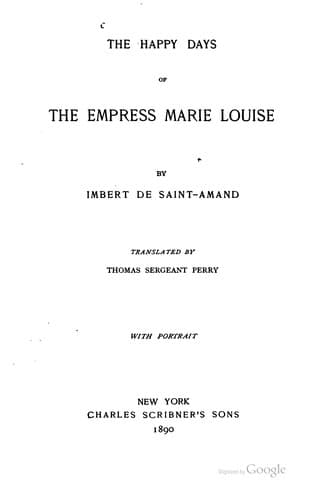
The Happy Days of the Empress Marie LouiseImbert de Saint-Amand
History
The Happy Days of the Empress Marie Louise
Imbert de Saint-Amand
Marie Louise, Empress, consort of Napoleon I, Emperor of the French, 1791-1847
Meanwhile the Champ de Mars, which was covered with flags, was filled
with three or four hundred thousand spectators, who had assembled
quietly, without crowding, on the terrace, the amphitheatres, and in the
walks. When Napoleon and Marie Louise showed themselves on the balcony
of the Military School, there broke out loud applause. Afterwards dinner
was served to the Imperial family. When that was finished, they gave the
signal for the horse and chariot races. Franconi's equestrian troupe
gave performances in the intervals. When all the prizes had been given,
a balloon, carrying a woman, Madame Blanchard, made an ascent. She
saluted the Imperial pair, waved a flag, threw down flowers, and
speedily attained a great height. Then there were fireworks. Amid
rockets, bombs, and shooting-stars, two pretty young women walked up and
down on the tight rope, like magical apparitions, amid the encircling
flames. After the fireworks a ballet was performed by the dancers from
the Opera, under the direction of Gardel; it represented the different
nations of Europe in their national dress. After the ballet came the
ball, which was most animated. Napoleon and Marie Louise left towards
midnight, escorted to their carriage by most of the guests, who cheered,
and did not return to the ball-room until the Emperor and Empress
had gone out of sight. This exceptional entertainment was favored by
pleasant weather and a bright night; the moon and the stars seemed to
rival the illuminations. The main courtyard, filled with trees and
flowers, was like the enchanted garden of Armida, where one walked amid
delicious music. At two in the morning the doors of the supper-room were
opened, a large bower of gilded trellis work, with Corinthian columns,
and a roof covered with frescoes representing groups of children
sporting in the air amid flowers and garlands. About fifteen hundred
people sat down to table.
The Imperial Guard had every reason to be proud of its entertainment.
The officers, young, brilliant, devoted to pleasure as to glory,
found their life more joyous as war threatened to make it short. They
displayed the same ardor, the same enthusiasm, in the ball-room as on
the battle-field. They loved the smell of flowers as much as the smell
of gunpowder. Every form of conquest tempted them, and they revived the
customs of chivalry. In the language of the time, there flourished the
twofold reign of Mars and Venus. In those heroic days courage was set
higher than wealth. The women, with few exceptions, were indifferent to
money; they did not think that an honorable scar disfigured a soldier's
face, and the disinterested kindness of a beauty was the reward of
bravery.
XVIII.
THE BALL AT THE AUSTRIAN EMBASSY.
Public-domain text, read in full here on John Shaqi.
Reviews
Reviews
No reviews yet
Be the first to share your thoughts on this work.
Elsewhere in the archive
Join the Discussion
Join the discussion
Sign in to leave a comment or review.
Sign InorCreate an account