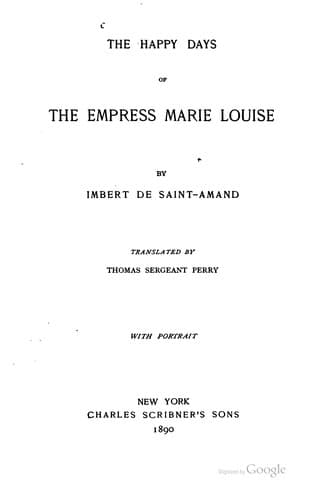
The Happy Days of the Empress Marie LouiseImbert de Saint-Amand
History
The Happy Days of the Empress Marie Louise
Imbert de Saint-Amand
Marie Louise, Empress, consort of Napoleon I, Emperor of the French, 1791-1847
After resting for two days at Düsseldorf, Napoleon and Marie Louise
went on to Cologne, when they visited the Chapel of the Eleven Thousand
Virgins, and a grand _Te Deum_ was sung in the famous Cathedral, They
returned by Liège, Givet, Mézières, and Compiègne, reaching Saint Cloud
after an absence of nearly three months,--the longest visit that the
Emperor had made in the provinces of either the old or the new France.
Everywhere he had met with the expression of two distinct but somewhat
different sentiments: for the Empress, an affectionate respect; for
himself, the sort of violent sensation that a man who is a living wonder
always produces. XXIV.
NAPOLEON AT THE HEIGHT OF HIS POWER.
At the beginning of 1812 Napoleon had reached the height of his power.
Before we watch his decline, it may be well to consider him at the
summit of his fortune, in the fulness of his force, might, and glory. In
his career there were two distinctly marked periods,--the democratic and
the aristocratic. In the early days of the Empire the first one had not
yet come to an end. The coins of that time still bore the stamp, "French
Republic. Napoleon Emperor." He himself resembled Caesar rather than
Charlemagne: he granted no hereditary titles, and associated with but
few of the émigrés; he was still, in many ways, a man of the Revolution.
In 1812, on the other hand, he had given his authority a sort of feudal
character, and revived many points of resemblance with the Carlovingian
epoch. Charlemagne had become his model, his ideal. The saviour of the
Convention, the friend of the young Robespierre, was busily introducing
much of the imperial and military splendor of the Middle Ages. The
continental sovereigns treated him with so much consideration that he
regarded himself as their superior rather than as an equal. He
called them his brothers; but he thought that he was more than a
brother--something like the head of a family of kings. The Kings of
Bavaria, of Würtemberg, of Saxony, of Spain, of Naples, of Westphalia,
who all owed their crowns to him, were indeed his subordinates. As
the Princes of the Confederation of the Rhine, the vassals of their
protector, they despatched their contingents to him with as much zeal
and punctuality as if they had been plain prefects of the Empire.
Public-domain text, read in full here on John Shaqi.
Reviews
Reviews
No reviews yet
Be the first to share your thoughts on this work.
Elsewhere in the archive
Join the Discussion
Join the discussion
Sign in to leave a comment or review.
Sign InorCreate an account