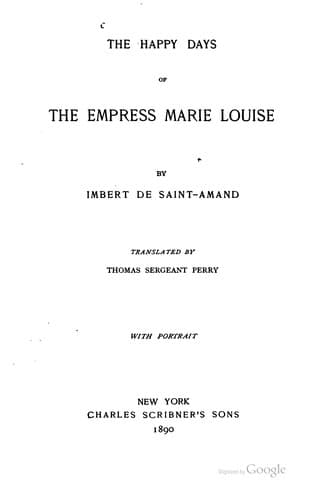
The Happy Days of the Empress Marie LouiseImbert de Saint-Amand
History
The Happy Days of the Empress Marie Louise
Imbert de Saint-Amand
Marie Louise, Empress, consort of Napoleon I, Emperor of the French, 1791-1847
The émigrés crowded the drawing-rooms of the Tuileries. One might have
thought one's self at Coblenz. Those men who belonged to the old régime
were especially appreciated. The one of his aides-de-camp who most
pleased the Emperor was perhaps the Count of Narbonne, knight of honor
of one of the daughters of Louis XV., Minister of War under Louis XVI.
The most rigid, the most precise etiquette prevailed in the Imperial
residences. The high dignitaries and marshals concealed their plebeian
names under pompous titles of princes and dukes. Madame de Mailly, the
widow of a marshal of the royal period, had been admitted to the rank
and privileges of the wives of the grand officers of the crown, and had
figured as a marshal's widow, at the reception of January 1, 1811. The
court of Versailles appeared to have revived.
Napoleon preferred to derive his power from divine right than from
the will of the nation. "He was much struck," Metternich says in his
Memoirs, "by the idea of ascribing the origin of supreme power to divine
choice. One day at Compiègne, soon after his marriage, he said to me, 'I
notice that when the Empress writes to her father, she addresses him as
His Holy Imperial Highness. Is that your usual way?' I told him he was
so addressed from the tradition of the old Germanic Empire, and because
he also wore the apostolic crown of Hungary. Napoleon then said with
some solemnity, 'It is a noble and excellent custom. Power derives from
God, and that is the only way it can be secure from human assault. Some
time or other I shall adopt the same title.'"
At about the same time, in conversation with M. Molé about the houses
building in Paris, on being asked when he intended to give his attention
to the Church of the Madeleine, the Emperor said, "Well, what is
expected of me?" M. Molé told him that he had heard that it was intended
for a Temple of Glory. "That's what people think, I know," said
Napoleon; "but I mean it for a memorial in expiation of the murder of
Louis XVI." He said to Metternich: "When I was young I favored the
Revolution out of ignorance and ambition. When I came to the age of
reason I followed its counsels and my own instinct, and crushed the
Revolution." At another time he said: "The French throne was empty.
Louis XVI. had not been able to hold it. If I had been in his place,
in spite of the immense progress it had made in men's minds during the
previous reigns, the Revolution would not have triumphed. When the King
fell, the Republic took its place; and I set that aside. The former
throne was buried under the ruins; I had to make a new one."
Public-domain text, read in full here on John Shaqi.
Reviews
Reviews
No reviews yet
Be the first to share your thoughts on this work.
Elsewhere in the archive
Join the Discussion
Join the discussion
Sign in to leave a comment or review.
Sign InorCreate an account