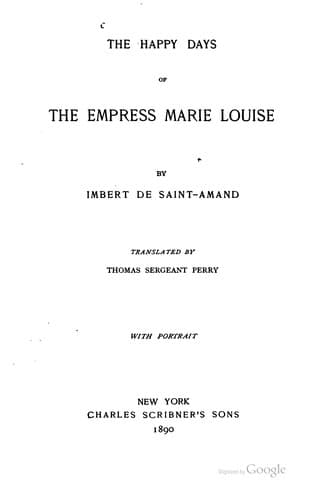
The Happy Days of the Empress Marie LouiseImbert de Saint-Amand
History
The Happy Days of the Empress Marie Louise
Imbert de Saint-Amand
Marie Louise, Empress, consort of Napoleon I, Emperor of the French, 1791-1847
Napoleon thought, spoke, and acted as if he had always been Emperor and
King. In the whole world there was no court so magnificent and brilliant
as his. Many kings were admitted to it only as French princes, high
dignitaries of the Empire: Joseph, King of Spain, was a Great Elector;
Murat, King of the Two Sicilies, Lord High Admiral; Louis Bonaparte,
deprived of the throne of Holland, figures in the Imperial Almanac of
1812 in his capacity of Constable. The other high dignitaries at this
epoch were Cambacérès, Duke of Parma, Lord High Chancellor of the
Empire; Lebrun, Duke of Piacenza, Lord High Treasurer, Governor General
of the Departments of Holland; Prince Eugene de Beauharnais, Viceroy of
Italy, Lord High Chancellor of State; Prince Borghese, Governor General
of the Departments beyond the Alps; Marshal Berthier, Prince of
Neufchâtel and of Wagram, Vice Constable; Talleyrand, Prince of
Benevento, Vice Great Elector. At the head of his military household,
the Emperor had four colonel-generals of the Imperial Guard, all four
marshals of France, Davoust, Duke of Auerstadt and Prince of Eckmühl;
Soult, Duke of Dalmatia; Bessières, Duke of Istria; Mortier, Duke of
Treviso. Moreover, there were ten aides-de-camp, nine of whom were
generals of divisions, and thirteen orderly officers. For Grand Almoner
he had Cardinal Fesch, Archbishop of Lyons, aided by four ordinary
almoners, two archbishops, and two bishops; for Grand Marshal of the
Palace, Duroc, Duke of Frioul; for High Chamberlain, the Count of
Montesquiou Fezensac; for First Equerry, General de Caulaincourt, Duke
of Vicenza; for Chief Huntsman, Marshal Berthier, Prince of Neufchâtel
and of Wagram; for Grand Master of Ceremonies, the Count of Ségur,
formerly the Ambassador of Louis XVI. to the great Catherine of Russia.
The Emperor had no fewer than ninety chamberlains, among whom figured
these among other great names of the old régime: an Aubusson de la
Teuillade, a Galard de Béarn, a Marmier, a d'Alsace, a Turenne, a
Noailles, a Brancas, a Gontaut, a Gramont, a Beauvau, a Sapicha, a
Radziwill, a Potocki, a Choiseul-Praslin, a Nicolay, a Chabot, a La
Vieuville. This aristocratic court knew no lack of amusements. The
winter of 1811-12 was one long succession of pleasures. "It was in the
whirl of these entertainments and festivities of all sorts," says Madame
Durand, first lady-in-waiting to the Empress, "that Napoleon formed
his plan for the conquest of Russia. The spoiled child of fortune,
intoxicated with flattery, never dreaming of the possibility of defeat,
seemed to be calculating his victories in advance, and to regard
pleasures as the preparations for war. Not a day passed without a play,
a concert, or a masked ball at court." The theatrical representations
on the Tuileries' stage were most impressive. The Emperor and Empress
occupied a box opposite the stage. The princes and princesses sat on
each side of them or behind; on the right was the box of the foreign
Public-domain text, read in full here on John Shaqi.
Reviews
Reviews
No reviews yet
Be the first to share your thoughts on this work.
Elsewhere in the archive
Join the Discussion
Join the discussion
Sign in to leave a comment or review.
Sign InorCreate an account