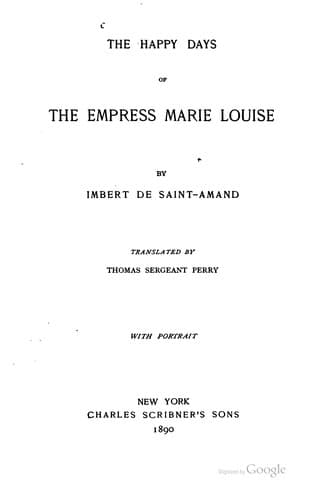
The Happy Days of the Empress Marie LouiseImbert de Saint-Amand
History
The Happy Days of the Empress Marie Louise
Imbert de Saint-Amand
Marie Louise, Empress, consort of Napoleon I, Emperor of the French, 1791-1847
According to Prince Metternich, "One of Napoleon's keenest and most
persistent regrets was that he could not appeal to the principle of
legitimacy as the foundation of his power. Few men have felt like him
the fragility and precariousness of authority without this basis, and
its vulnerability to attacks." One day, in speaking to the Austrian
statesman about the letter he wrote when First Consul to Louis XVIII.,
he said: "His answer was dignified and rich in impressive traditions. In
Legitimists there is something which lies outside of their intelligence.
If he had consulted his intellect alone, he would have come to terms
with me, and I should have treated him most generously."
The Emperor had come to regard himself as the glorious personification
of divine right, and as the defender of all the monarchies. In his eyes
the King of Prussia was only a revolutionary monarch. If we may believe
Chateaubriand, "Frederick William's great crime, according to Bonaparte
the Republican, was this, that he abandoned the cause of the kings. The
negotiations of the Berlin court with the Directory indicated, Bonaparte
used to say, a timid, selfish, undignified policy, which sacrificed his
own position and the general monarchical interests to petty advantages.
When he used to look at the new Prussia on the map he would say, 'Is it
possible that I have left that man so much territory?'"
The philosophers aroused as much horror in Napoleon as the Jacobins.
In his eyes strong minds were weak minds; and though he persecuted the
Pope, he denounced with equal severity attacks on the throne and attacks
on the Church. He especially detested the Voltairian irony, regarding
it as both blasphemous and treasonable. To quote once more from Prince
Metternich: "He had a profound contempt for the false philosophy as well
as for the false philanthropy of the eighteenth century. Of all the
founders of the doctrine it was Voltaire who was his pet aversion, and
he carried his hate so far as to attack on every occasion his general
literary reputation."
Public-domain text, read in full here on John Shaqi.
Reviews
Reviews
No reviews yet
Be the first to share your thoughts on this work.
Elsewhere in the archive
Join the Discussion
Join the discussion
Sign in to leave a comment or review.
Sign InorCreate an account