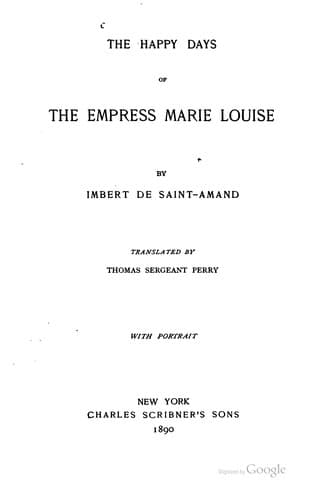
The Happy Days of the Empress Marie LouiseImbert de Saint-Amand
History
The Happy Days of the Empress Marie Louise
Imbert de Saint-Amand
Marie Louise, Empress, consort of Napoleon I, Emperor of the French, 1791-1847
December 19, 1832, Victor Hugo, in a speech before the Court of Commons,
where he was trying to compel the government to let "Le Roi s'amuse" be
given, spoke thus of the Imperial government: "Then, sirs, it is great!
The Empire, in its administration and government, was, to be sure, an
intolerable tyranny, but let us remember that our liberty was largely
paid for with glory. At that time France, like Rome under Caesar,
maintained an attitude at once submissive and proud. It was not the
France we desire, free, ruling itself, but rather a France, the slave of
one man, and mistress of the world. It used to be said, 'On such a day,
at such an hour, I shall enter that capital,' and they entered that day
and at that hour. All sorts of kings used to elbow one another in
his ante-chambers. A dynasty would be dethroned by a decree in the
_Moniteur_. If a column was wanted, the Emperor of Austria used to
furnish the bronze. The control of the French comedians was, I confess,
a little arbitrary, but their orders were dated from Moscow. We were
shorn of all our liberties, I say; there was a rigid censorship, our
books were pilloried, our posters were torn down; but to all our
complaints a single word sufficed for a magnificent reply; they could
answer us with Marengo! Jena! Austerlitz!"
And the poet thus ended his speech: "I have but a few more words to
say, and I hope that you will remember them when you proceed to your
deliberations. They are these: 'In this century there has been only one
great man--Napoleon; and only one great thing--Liberty. We no longer
have the great man; let us try to have the great thing.'"
Certainly he exceeded the common measure, that man of whom
Chateaubriand, his implacable foe, said: "The world belongs to
Bonaparte. What that destroyer could not finish, his fame has seized.
Living, he missed the world; dead, he possesses it. You may protest,
but generations pass by without hearing you." When some one asked the
illustrious author why, after so violently attacking Napoleon, he
admired him so much, the answer was, "The giant had to fall before I
could measure his height."
Public-domain text, read in full here on John Shaqi.
Reviews
Reviews
No reviews yet
Be the first to share your thoughts on this work.
Elsewhere in the archive
Join the Discussion
Join the discussion
Sign in to leave a comment or review.
Sign InorCreate an account