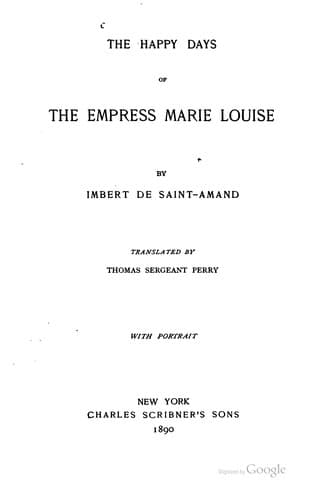
The Happy Days of the Empress Marie LouiseImbert de Saint-Amand
History
The Happy Days of the Empress Marie Louise
Imbert de Saint-Amand
Marie Louise, Empress, consort of Napoleon I, Emperor of the French, 1791-1847
Those who were nearest to Napoleon regarded him as an almost
supernatural being. The Baron of Méneval, who, before he was the private
secretary of Marie Louise, when regent, had been secretary of the First
Consul and Emperor, thus writes: "By the influence which Napoleon
exercised on his age he was more than a man. Never perhaps will a human
being accomplish greater things than did this privileged creature in so
few years, in the face of so many obstacles; yet these were inferior
to those of which the plans lay in his mighty head. The memory of that
time, of the hours I spent with this wonderful man, seems to me a dream.
In the deep feeling which he arouses in me, I have to bow before
the impenetrable decrees of Providence, which, after inspiring this
wonderful instrument of its plans, tore him from his uncompleted work.
Possibly God did not wish him to anticipate the time He had established
by an invariable order. Possibly He did not wish a mortal to exceed
human proportions!"
If Napoleon was thus admired, even after the terrible catastrophes which
wrought his ruin, even after the retreat from Russia, after the two
invasions, after Waterloo, what an impression he must have made on his
enthusiastic partisans when he was the incarnation of success and glory,
when there was no spot on the sun of his omnipotence, and, protected
by some happy fate, he had disarmed envy, discouraged hate, and so far
bound Fortune that she seemed to tremble before him like an obedient
slave!
In spite of the glory which surrounded him in 1812, Napoleon, who is
often represented as infatuated with himself and his glory, yet even at
this moment of colossal power and unheard-of prosperity, had moments
when he judged himself with perfect impartiality. He knew human nature
thoroughly, and he indulged in no illusions about his family, which
he distrusted, or about his marshals, whose desertion he seemed to
anticipate, or about his courtiers, whose flatteries did not deceive
him. Being convinced that interest is generally the sole motive of
human actions, he expected neither devotion nor gratitude. "One day, in
speaking to my father," says General de Ségur, "he asked him what he
thought people would say about him after his death, and my father began
to enlarge on the way we should mourn for him. 'Nothing of the sort!'
interrupted the Emperor; 'you would all say, "Ah!"' and he accompanied
this word with a consolatory gesture which expressed 'at last we can
take a long breath and be at peace.'" It was not after his defeats that
the Emperor said this, but in 1811, when still mighty and successful.
Public-domain text, read in full here on John Shaqi.
Reviews
Reviews
No reviews yet
Be the first to share your thoughts on this work.
Elsewhere in the archive
Join the Discussion
Join the discussion
Sign in to leave a comment or review.
Sign InorCreate an account