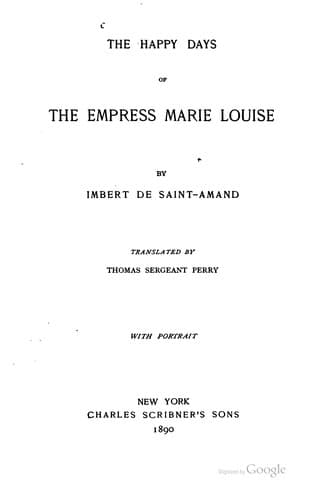
The Happy Days of the Empress Marie LouiseImbert de Saint-Amand
History
The Happy Days of the Empress Marie Louise
Imbert de Saint-Amand
Marie Louise, Empress, consort of Napoleon I, Emperor of the French, 1791-1847
to deny everything: the other never dissimulated, and hated everything
roundabout. My first wife never asked for anything, but she ran up debts
right and left; my second always asked for more when she needed it,
which was seldom. She never bought anything without feeling bound to pay
for it on the spot. But both were kind, gentle, and devoted to their
husband."
Marie Louise did not shine in a drawing-room like Josephine; that would
have required a French tact which she did not in the least possess. The
first Empress was thoroughly familiar with French society, which the
second did not know at all. Josephine had seen the last brilliancy of
the old regime and the golden days of the Revolution; she had been a
conspicuous figure in that brilliant but, above all, amusing period, of
which Talleyrand said, "No one who did not live before 1789 knows how
charming life can be." As Viscountess of Beauharnais, she was intimate
with the most intelligent persons in Paris. Though far less educated
than Marie Louise, her conversation was more animated and had a wider
range. No subject was too deep for her; and although she never said
anything very important, she always could give what she had to say an
agreeable turn. Her most ardent desire was to make people forget, by her
fascinations, that she was not born to the throne, and she seemed always
endeavoring to be pardoned for her elevation into the society of the
Faubourg Saint Germain. The names of the great French families always
made much more impression on her, who had risen from the people, than on
Marie Louise, who by birth as well as position could look down on all
the French ladies without exception. It was not those who had belonged
to the old régime whom she preferred; Madame Lannes was far more
congenial to her than the Princess of Beauvau or the Countess of
Montesquieu. She never sought to flatter the Faubourg Saint Germain, but
rather kept it at a distance, making none of the advances to which it
was accustomed at the hands of the first Empress. She felt that the
Royalists secretly blamed her for attaching her old coat-of-arms to the
new fortune of Bonaparte. She belonged to a race which had never felt a
warm love for the Bourbons; while Josephine, who was born in a family of
Royalists, had remained faithful, even when on the Imperial throne, to
her devotion to the old Royalty. Marie Louise indulged in no illusions.
She knew that the courtiers, under the appearance of adoration which
amounted to servility, were really concealing a depth of malice and
ill-will, which was the more dangerous the more it was hidden, and that
the very ones who were burning incense before her would be the most
delighted to catch her tripping. Hence she was always on her guard,
and in public steadily maintained an attitude of cold benevolence and
discreet reserve. Napoleon loved her, for the very reason that her
qualities were the exact opposite of those of Josephine; and if she had
Public-domain text, read in full here on John Shaqi.
Reviews
Reviews
No reviews yet
Be the first to share your thoughts on this work.
Elsewhere in the archive
Join the Discussion
Join the discussion
Sign in to leave a comment or review.
Sign InorCreate an account