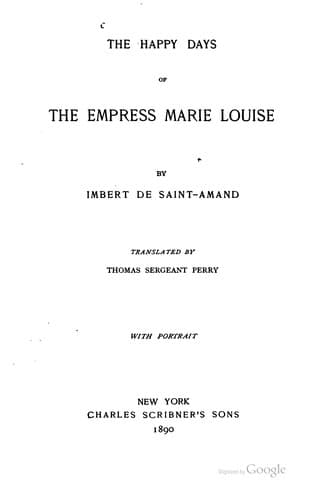
The Happy Days of the Empress Marie LouiseImbert de Saint-Amand
History
The Happy Days of the Empress Marie Louise
Imbert de Saint-Amand
Marie Louise, Empress, consort of Napoleon I, Emperor of the French, 1791-1847
striven to copy the former Empress, she would only have sunk in her
husband's estimation. He had bidden her never to forget that she was a
sovereign, as he was always Emperor: she obeyed him, and she did right
to obey him. Strong in her husband's approval,--for he never had
occasion for the slightest reproach,--she persisted in the very prudent
and dignified line of conduct that she had adopted on entering France.
She had every reason to be proud of her success; for so long as she
lived with Napoleon, no whisper of calumny attacked her, no faintest
insinuation was breathed against her morality. At Saint Helena, the
Emperor said, "Marie Louise was virtue itself."
The untiring precision of her demeanor and of her words protected the
Empress from criticism, but aroused no enthusiastic praise. She was more
esteemed than loved; and, in spite of her precocious wisdom, she aroused
no fervent sympathy, none of the enthusiastic admiration which less
reserved, more amiable queens have inspired. Still, no one found fault
with her. Count Miot de Mélito, in describing a reception at the
Tuileries in 1811, says: "The Empress entered.... Her face wore a
dignified but somewhat disdainful expression. She walked round the
room, accompanied by the Duchess of Montebello, and spoke agreeably and
pleasantly with a number of people whom she had introduced to her, and
all were gratified by their kindly reception."
The Duke of Rovigo, the Minister of Police, speaks thus in his Memoirs:
"Marie Louise aroused enthusiasm whenever she opened her mouth. Her
success in France was entirely her own work; for I declare, on my honor,
the authorities never adopted any particular methods to secure for her a
warm welcome from the public. When she was to appear in a procession
or at the theatre, all the authorities did was to provide against the
slightest breach of order or propriety; beyond that, nothing was done.
For example, when I was told that she was going to the theatre, I used
to take all the boxes opposite the one she was to occupy, and all others
from which people might stare at her. Then I took the precaution of
sending the tickets for these boxes to respectable families, who were
very glad to use them. In this way I filled the balcony on the days when
the Empress meant to be present. As to any steps towards insuring a
warm welcome from the pit, I simply did not take any. The Empress Marie
Louise was accustomed, when she came before the public, to make three
courtesies, and so gracefully that the applause always broke out with
great warmth before the third. It was she herself who bade me take no
active steps on such occasions." After thus greeting the audience, the
Empress used to sit modestly in the back of the box. To be gazed at
through all the opera-glasses always annoyed her. Her lofty rank, the
pride of her position, which would have filled other women with rapture,
left her almost indifferent.
Public-domain text, read in full here on John Shaqi.
Reviews
Reviews
No reviews yet
Be the first to share your thoughts on this work.
Elsewhere in the archive
Join the Discussion
Join the discussion
Sign in to leave a comment or review.
Sign InorCreate an account