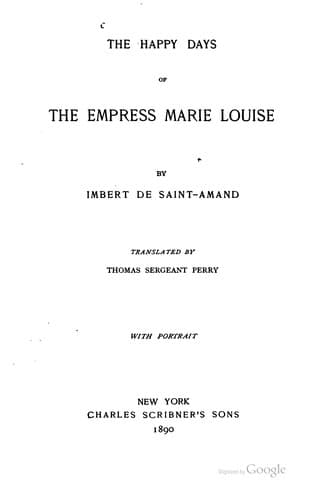
The Happy Days of the Empress Marie LouiseImbert de Saint-Amand
History
The Happy Days of the Empress Marie Louise
Imbert de Saint-Amand
Marie Louise, Empress, consort of Napoleon I, Emperor of the French, 1791-1847
affection in a victor's captive. She was too natural to simulate love
where she felt only obedience, terror, and resignation. History will
blame her; nature will pity her.... She was expected to play a part; she
failed as an actress, but as a woman she has survived."
The Marie Louise who is thus described by Lamartine is not the Marie
Louise of the beginning of 1812; then the young Empress did not regard
herself as "a victor's captive," nor as "a foreign decoration attached
to the columns of the throne." Napoleon did not inspire her with terror,
and she knew none of the constraint which "lessened her natural charms,
darkened her expression, dimmed her wit, and burdened her heart." She
did not look upon her court as a "magnificent but rude exile." These
thoughts may have occurred to her in misfortune, but hardly, we think,
before the Russian campaign. If Lamartine had read the letters which she
wrote to her father in 1810, 1811, and the beginning of 1812, he would
doubtless have acknowledged that for some time Napoleon's second wife
was happy on the French throne.
To this portrait drawn by the great poet we prefer the one we find in
Méneval's Memoirs: "The better Napoleon learned to know the Empress, the
more he applauded his choice. Her character seemed made for him; she
brought him happiness and consolation amid the cares of his stormy
career. In ordinary life she was simple and kindly, yet with no loss of
dignity. No word of complaint or blame ever crossed her lips. Gentle,
but reserved and discreet, she never expressed her feelings with any
vivacity. She was kind and generous, simple and astute at the same time;
her gayety was gentle, her wit without malice. Though well-informed, she
made no parade of her acquirements, fearing to be accused of pedantry.
Her wifely devotion had won the Emperor's affection, and her unfailing
gentleness had attracted all his friends. In this estimate I am
confirmed by my recollections, and I am not inspired by any partiality,
by what has happened, or by any present interest. It would be a mistake
to suppose that her duty and her inclinations were at variance; she was
perfectly natural and could not conceal her real impressions; but events
have shown that while she inclined to virtue when it was easy, she yet
lacked the strength to practise it when it was hard."
Public-domain text, read in full here on John Shaqi.
Reviews
Reviews
No reviews yet
Be the first to share your thoughts on this work.
Elsewhere in the archive
Join the Discussion
Join the discussion
Sign in to leave a comment or review.
Sign InorCreate an account